Contents
4 parts · 14 sections
 About Us
Compare sliding vs. hinged shower doors by entry width, swing space, water drips, cleaning, upkeep, and price to find the right fit.
Choose / Comparison guide
4 parts · 14 sections
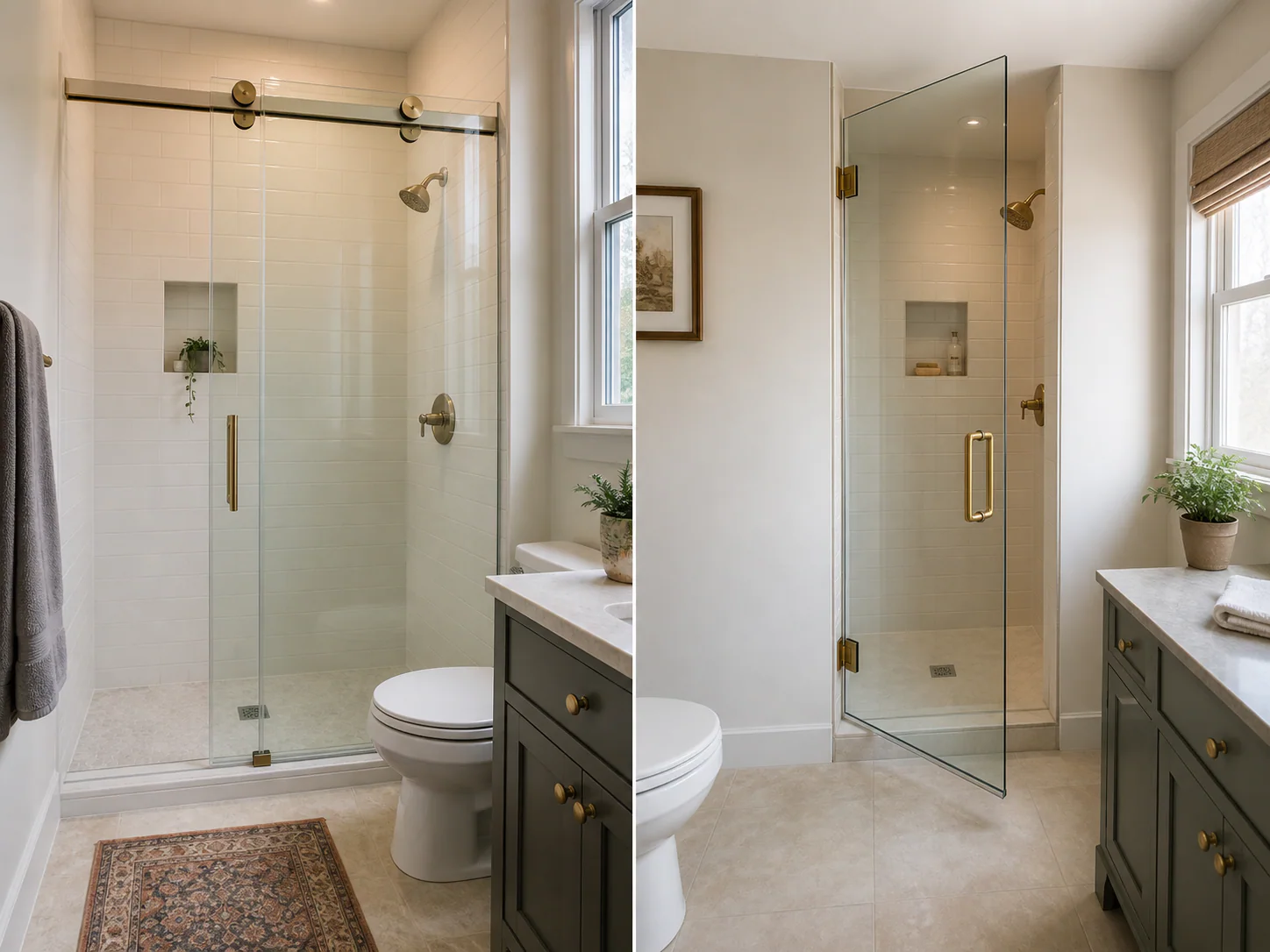
Sliding and hinged shower doors can both fit the opening and look right in photos. Living with them is different. Sliding doors usually suit tight layouts and keep wet glass above the shower. Hinged doors often give you a more direct entrance and easier access to the glass for cleaning. Your bathroom and routine will decide which set of drawbacks is easier to manage.
A short Home Depot review illustrates the issue. Becky, a verified purchaser of a Basco Infinity hinged shower door, liked its appearance, said it kept water inside, and thought the clear glass made the bathroom look larger. She also noted that a little water came out when she opened the door and considered that normal.
The door contained water during the shower. Once it opened, the wet glass moved over the bathroom floor and carried a few drops with it. That part of ownership is easy to miss in a product photo.
The review stops there. Becky did not describe a daily cleanup routine, and we should not invent one for her. Her verified owner review still raises a useful buying question: which small inconvenience would you rather handle for the next several years?
A sliding door usually keeps the moving glass above the shower base or tub, avoiding that particular swing-over-floor problem. You may have overlapping panels, rollers, guides, seals, or tracks to clean instead.
You will be managing one set of drawbacks or the other. Choose the set that fits the room and the way you use it.
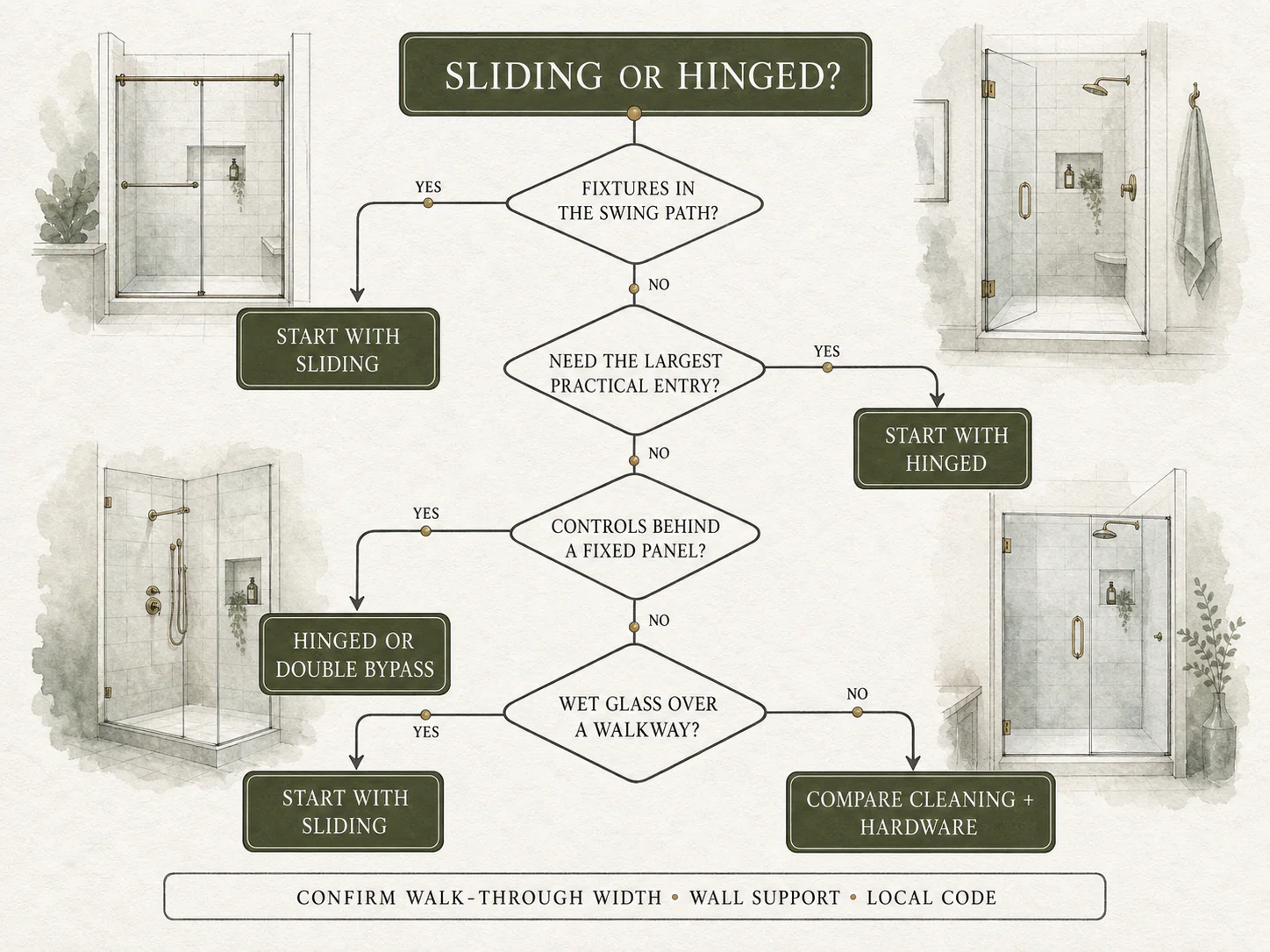
Choose a sliding shower door when fixtures crowd the opening, wet glass would swing over the floor, or you need access from either end of a tub. Choose a hinged door when the swing path is clear and you want a more open entry with easier access to the glass. Always check the exact model’s walk-through width.
| What matters most | Better starting point | Why |
|---|---|---|
| A toilet or vanity sits close to the shower | Sliding | No glass panel swings across the bathroom |
| You want the widest possible entrance | Hinged | The moving panel can clear the entry completely |
| Wet glass would open over a bath mat or walkway | Sliding | The moving panel usually stays above the enclosure |
| You want easy access to most of the glass | Hinged | There is less panel overlap to reach behind |
| You use a tub to bathe children | Double bypass sliding | Either side may open, depending on the model |
| You dislike deep tracks | Hinged or low-guide slider | Both can avoid a traditional bypass bottom channel |
| Your home has hard water | Hinged or an easy-access slider | Reachable surfaces are faster to descale |
| The bathroom has generous open floor space | Either | Entry, valve access, and cleaning matter more than swing space |
Both designs can work well. A well-planned slider can be easier to live with than a hinged door that blocks the toilet. A properly sized hinged door may feel better than a slider with a narrow walk-through.
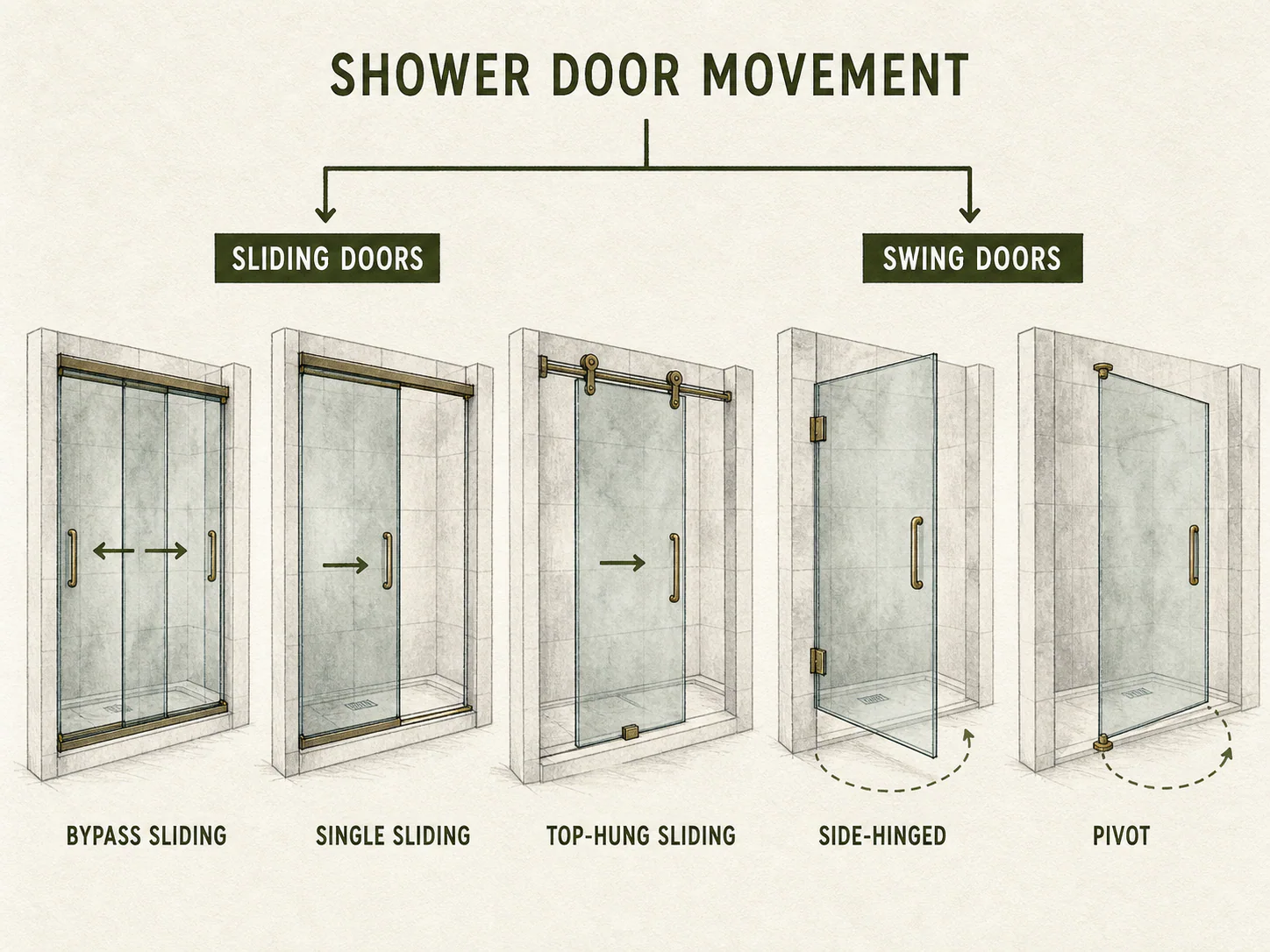
Retail listings use these terms inconsistently. In this guide, hinged is the broad consumer term for shower doors that swing open. Side-hinged and pivot describe two hardware arrangements within that swing-door family. Identify the door by how the glass moves, then check the exact model rather than relying on the marketing name.
| Term | What moves |
|---|---|
| Bypass sliding | Two panels slide past each other |
| Single sliding | One panel slides in front of a fixed panel |
| Barn-style or top-hung sliding | A panel hangs from an upper rail and uses rollers, often with a small floor guide |
| Swing door (hinged or pivot) | The glass rotates open instead of sliding |
| Side-hinged | The door swings on hinges attached near one vertical edge |
| Pivot | The door swings on top-and-bottom pivot hardware, sometimes with the pivot axis set in from the glass edge |
A complaint about an old framed bypass track does not automatically apply to a modern top-hung slider. A pivot door belongs to the same swing-door family as a side-hinged door, but the hardware and pivot location can change clearance, sealing, and structural requirements. Check the installation manual for the exact model before comparing either one. If you are still deciding among frame and door configurations, begin with our frameless shower door selection guide.
This is a comparison of opening mechanisms, not a test of every shower door on the market. We used eight daily-use criteria: valve access, usable entry width, door movement, water behavior, cleaning access, wear parts, structural requirements, and price. General conclusions apply to the mechanism only when the design makes them reasonable. Model-specific claims name the exact product.
Dimensions and installation requirements come from manufacturer specifications and manuals. The code note uses ICC-published text, and the opening story is clearly attributed owner feedback. For the price comparison, we selected two premium frameless doors from the same retailer, in roughly the 60-inch size class, with 3/8-inch glass. Both systems pair one moving door panel with one fixed glass panel. We recorded both prices on September 2, 2026. Those two prices are examples, not category averages.
We did not install or personally use the doors named in this guide. Use the comparison to choose a mechanism and identify questions for the seller or installer. Final fit, wall support, and code compliance depend on the exact model and site conditions, so confirm the current listing, installation manual, and local requirements before ordering.
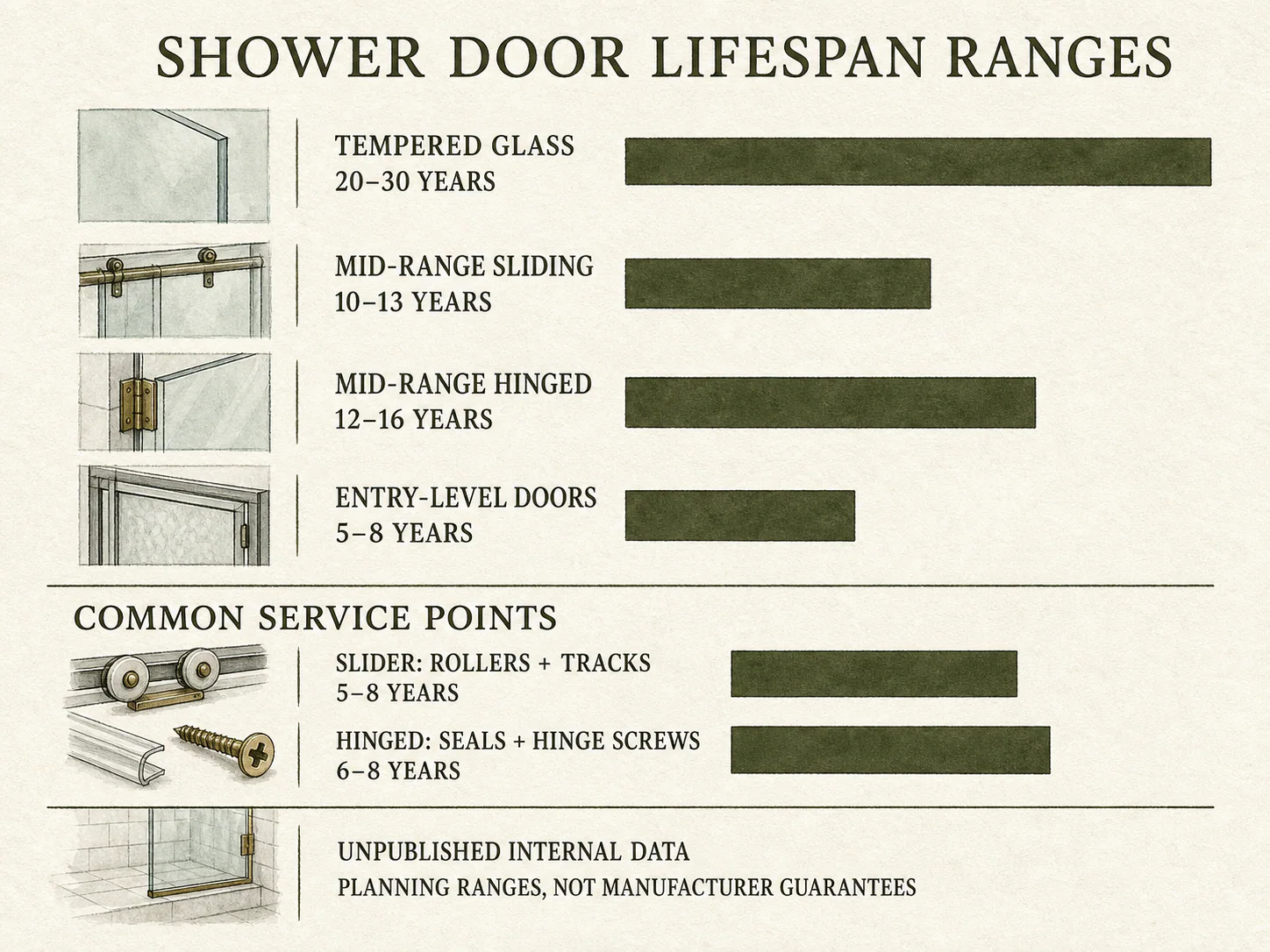
The lifespan ranges in the FAQ come from Aurivedo’s internal data. We present them as planning estimates, not manufacturer guarantees for a specific product.
Picture a 60-inch alcove with a single sliding door. The movable panel is on the opposite side from the shower controls. To turn on the water, you have to reach around the fixed glass or step partly into the shower while the water warms up.
A double bypass door may solve that problem because both panels can move. A hinged door can also work well when its handle and opening sit near the valve.
Before ordering, stand outside the finished shower and act out the routine. Where will the glass be when you reach for the valve? Can you turn on the water without stepping into the spray? The valve location can matter as much as the door mechanism.
A 60-inch finished opening does not give you a 60-inch entrance. Fixed glass, overlapping panels, handles, and hardware all take up space.
For example, VIGO publishes a 22 to 26-inch walk-through for its Elan VG6041STCLSC6076, even though the door fits finished openings from 56 to 60 inches. The exact entry changes with the installed width. Those figures come from the VIGO Elan product specifications, not an estimate based on the product photo.
Use the published walk-through width for the exact model. A hinged door is not automatically wider, and a slider is not automatically narrow. The wall-to-wall opening and the width printed in a product title are not substitutes for the usable entry measurement.
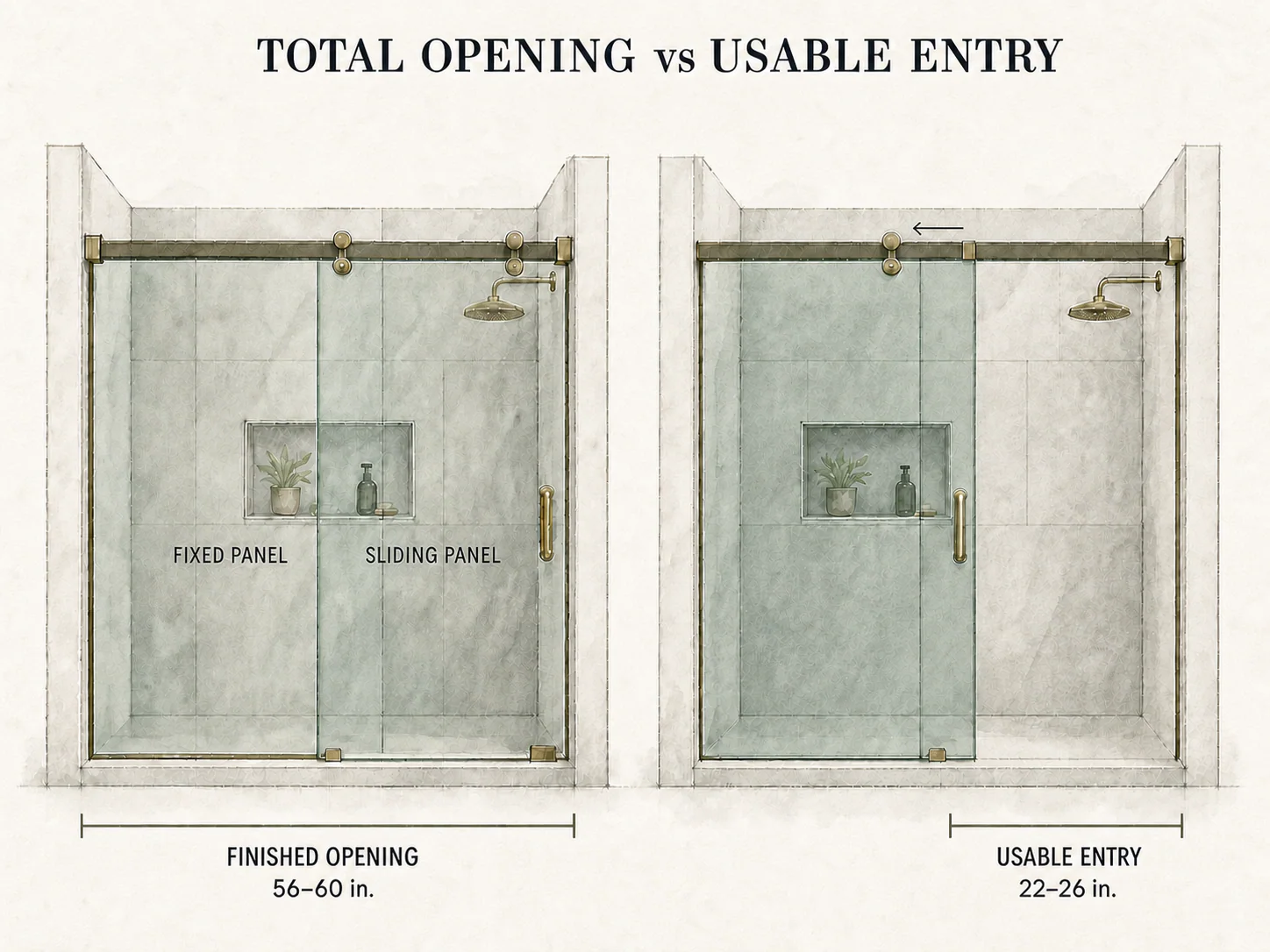
Walk through a taped 22-inch gap, then try the width of the other model you are considering. Do it while carrying a towel basket or helping a child. A few inches are easier to judge with your body than on a specification sheet.
Because a sliding panel travels parallel to the opening, it does not need clear floor space outside the shower. This often makes a slider a better fit when the toilet, vanity, towel bar, or bathroom door is close by.
A hinged door needs a clear swing path. Check the handle as well as the glass edge, since a projecting handle can reach a fixture first.
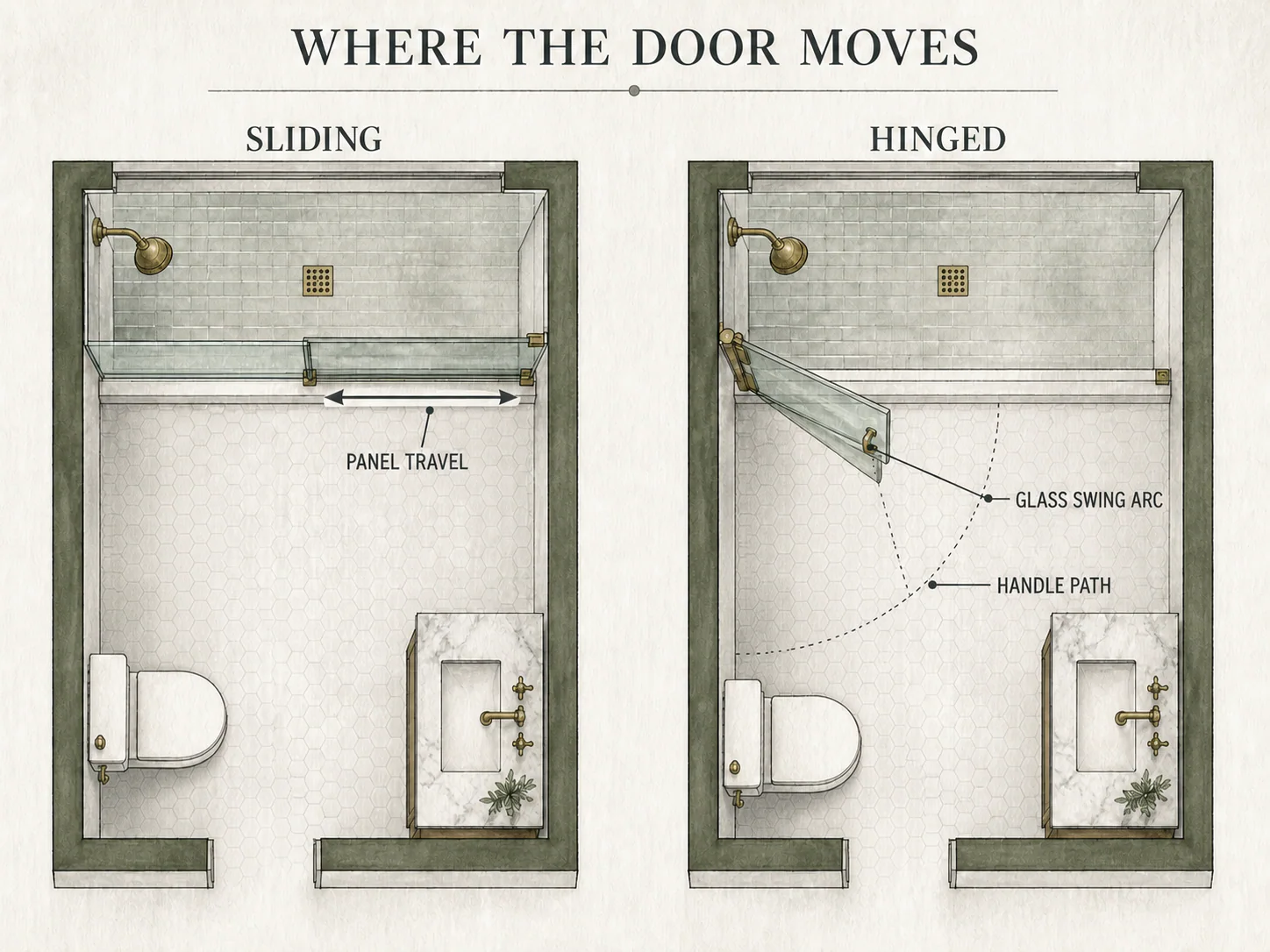
Mark the swing arc and handle projection on the floor with painter’s tape. Then open the vanity drawers, sit on the toilet, open the bathroom door, and stand where you normally dry off. This five-minute check reveals conflicts that a flat floor plan may hide.
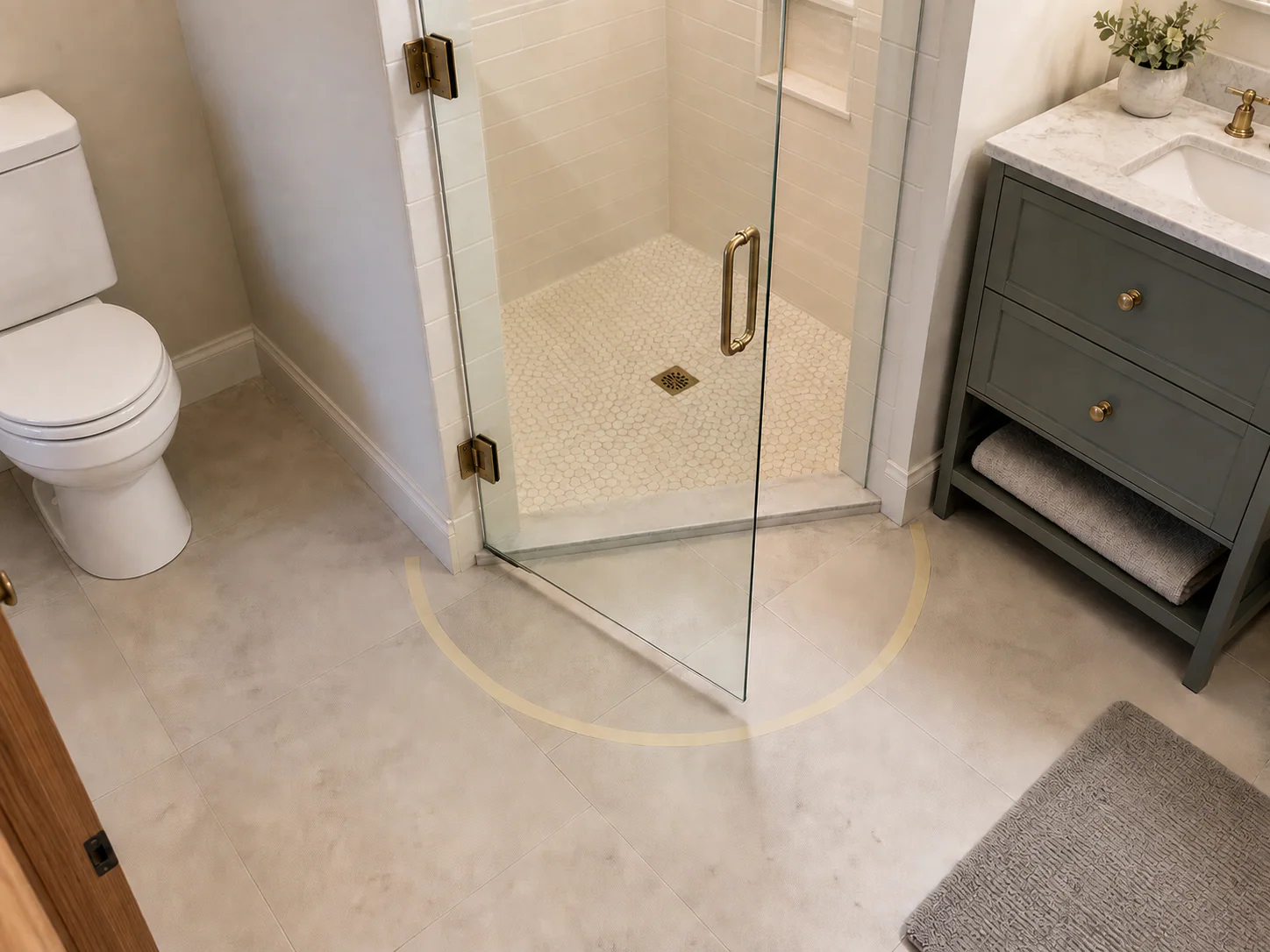
For full instructions on measuring the finished opening, checking wall plumb, and recording clearance, use our guide to measuring for a shower door.
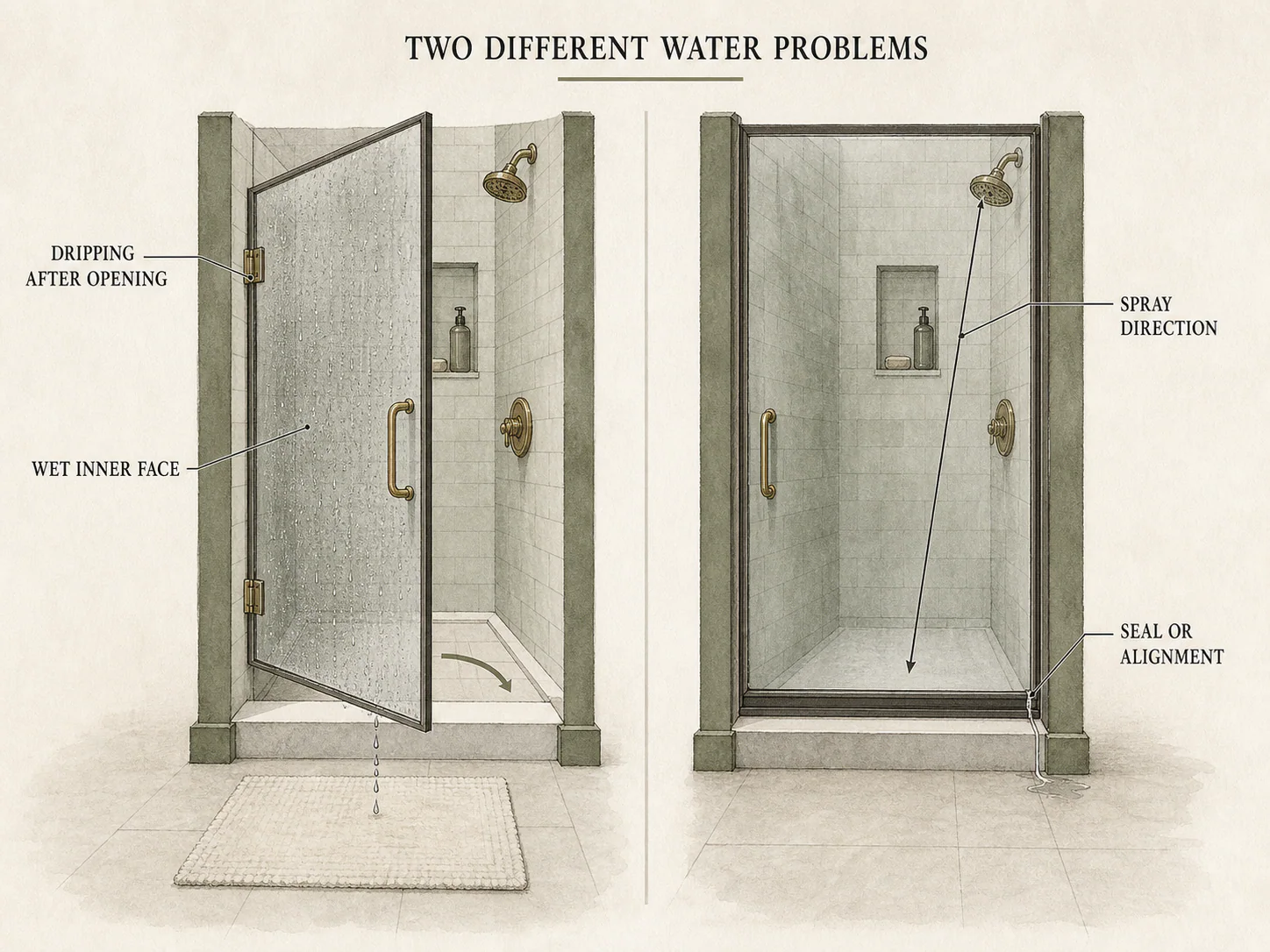
Water outside the shower can come from two different events. Treating them as one problem leads to bad product comparisons and bad repairs.
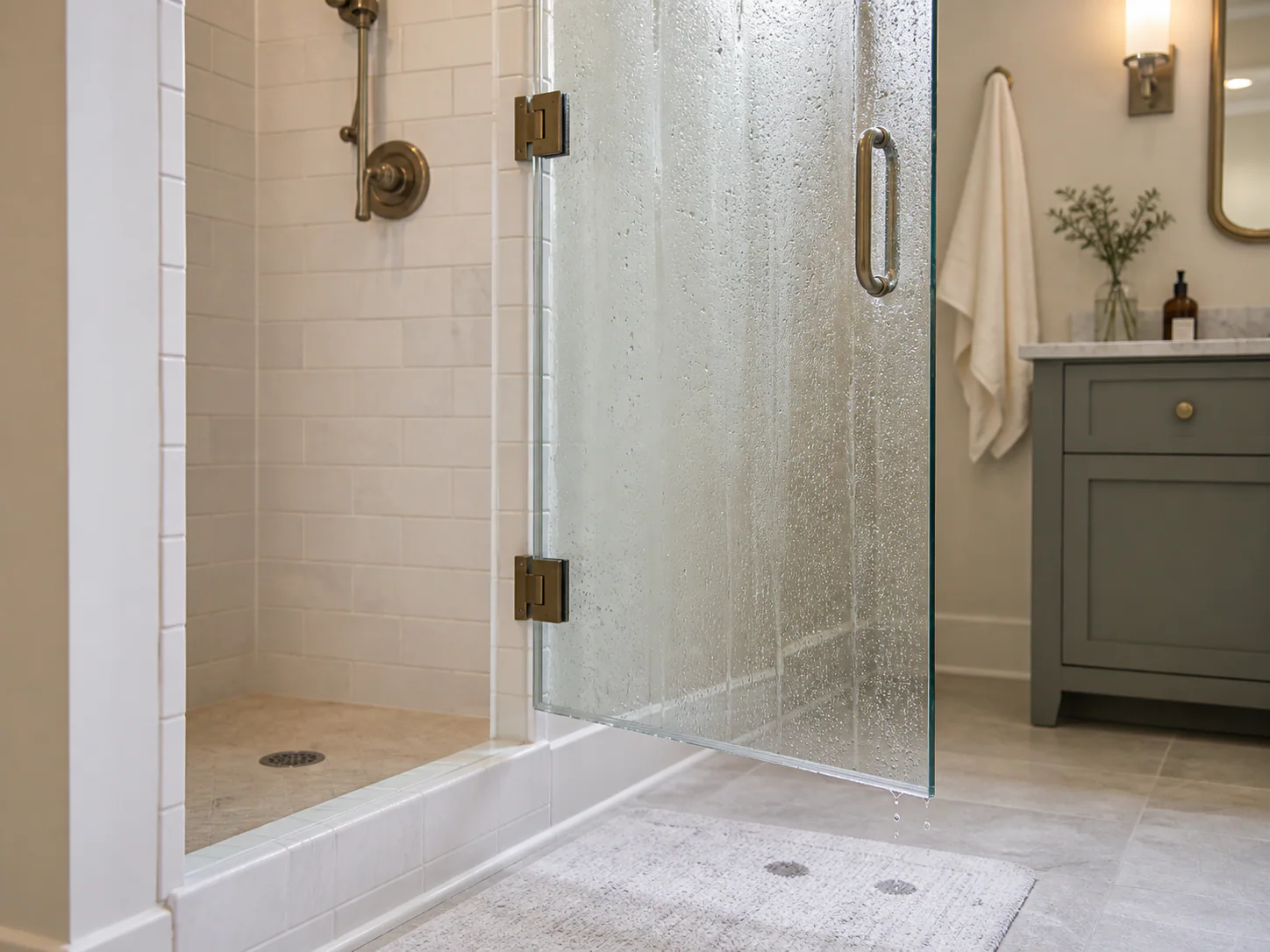
A hinged door may seal correctly while closed and still drop water afterward. Water remains on the inside face of the glass. When the door swings outward, that wet surface moves over the bathroom floor.
Becky’s Basco review describes water appearing when the door opened. It tells us nothing about leakage while the shower was running.
A slider usually keeps the wet panel above the shower base or bathtub while it opens. That can reduce the water carried over a bath mat or walkway. A glass coating and squeegee can also reduce residual water, but the squeegee becomes part of the routine.
Closed-door leakage has more possible causes: spray direction, water pressure, bottom sweeps, side seals, panel overlap, threshold shape, curb slope, wall plumb, and installation accuracy.
Either mechanism can leak when the water path and seals are wrong. If water escapes while the enclosure is closed, check the installation and spray direction before blaming the whole door category.
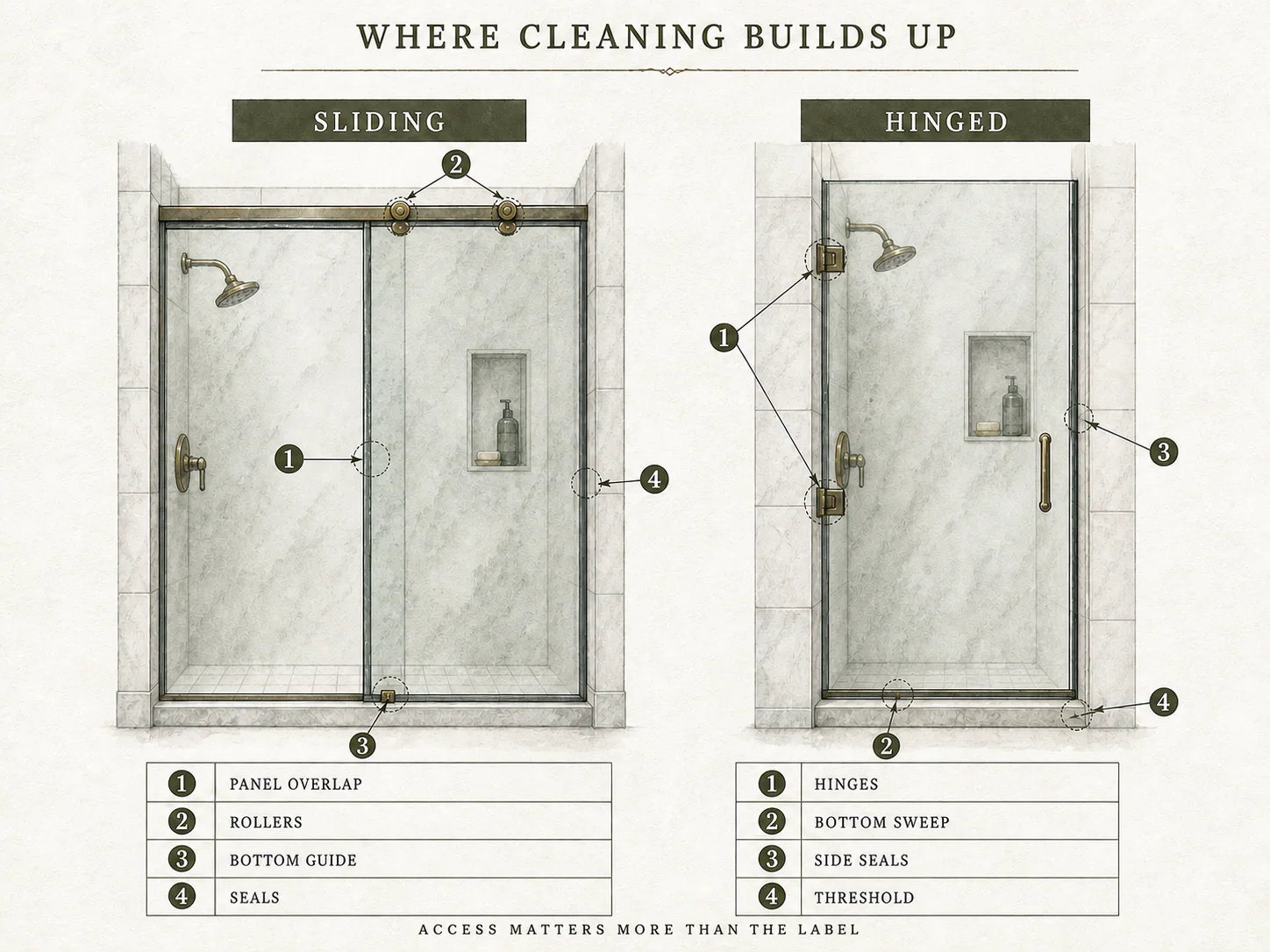
Hinged doors usually give you direct access to both sides of the moving glass. They still have hinges, sweeps, seals, and a threshold to clean, but there is less overlapping glass.
Traditional bypass sliders can collect soap and minerals in bottom tracks, drain slots, guides, seals, and the overlap between panels. Modern sliders vary. A top-hung design with a small floor guide is easier to reach than a deep framed channel, although the panel overlap and roller area still need attention.
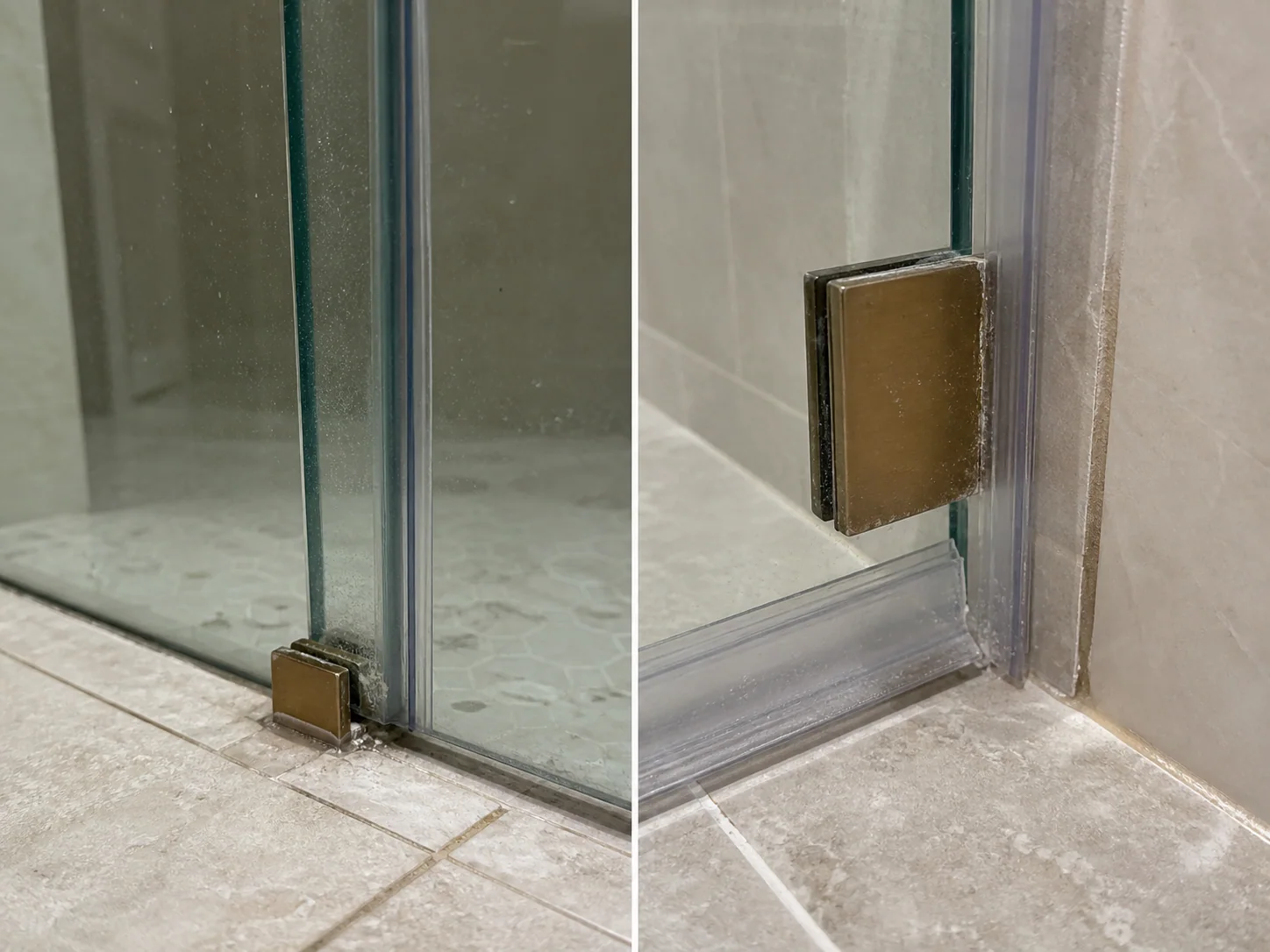
Hard water makes access more important. Water-repellent coatings can slow buildup, but they do not remove minerals or eliminate cleaning. Look at every place water can dry. Can your hand and cleaning tool reach it without removing hardware?
You are more likely to keep up with a surface you can wipe in five minutes. A surface that needs a toothbrush, a scraper, and an awkward reach between panels is more likely to become irritating, no matter how clean it looked in the showroom.
You will open the door thousands of times. Door weight, handle shape, roller adjustment, hinge resistance, and installation quality affect how that action feels.
The current VIGO Elan listing describes a soft-closing sliding mechanism. Other sliders use simpler rollers and stops. Hinged doors also vary, from light framed panels to heavy 3/8-inch frameless glass on wall-mounted hinges. Try a comparable display model if you can, but confirm the model number because showroom hardware may differ from the door you plan to buy.
Sliding systems commonly use rollers, guides, seals, and stops as service parts. Hinged systems shift more attention to hinges, alignment, bottom sweeps, and side seals. Before buying either type, check whether the manufacturer sells the wear parts separately.
Heavy frameless hinged glass also needs proper wall support. DreamLine’s Unidoor installation manual states that its hinges must attach to studs or preinstalled 2 × 6 wood reinforcement. That requirement is model-specific, but it shows why the installation manual needs to be checked before the tile is finished. Confirm the structure and fasteners with your installer.
Price comparisons become misleading when a framed bypass door is placed beside a custom frameless enclosure. To meaningfully compare prices, align for opening‑size range, glass thickness, hardware finish, hardware grade, and number of glass panels.
There is no simple rule that sliding doors are consistently cheaper or more expensive than hinged doors. Premium frameless sliding and hinged systems occupy heavily overlapping price bands. Final cost is driven more by glass size, hardware quality, finish grade, and custom requirements than by the door’s opening mechanism alone. Framed and semi‑frameless alternatives sit at much lower price tiers.
Also factor in long‑term ownership costs beyond the upfront purchase price: recurring cleaning effort, and the availability and price of replacement wear‑parts such as rollers, hinges, seals and sweeps. Saving ten minutes each week on cleaning would add up to roughly 43 hours over five‑years of use. This calculation is purely illustrative, not a measured real‑world result for any specific door model.
| Your situation | Better place to start | What you may notice every day |
|---|---|---|
| Toilet or vanity sits beside the shower | Sliding | The door does not swing into the fixture |
| You bathe children in a tub | Double bypass sliding | You may open either side for access |
| You dislike cleaning overlaps and deep tracks | Hinged or low-guide slider | More wet surfaces are within easy reach |
| You want the largest practical entrance | Properly sized hinged | The moving panel can clear the entry |
| Controls sit behind a fixed panel | Hinged or double bypass sliding | You can reach the valve before stepping in |
| Wet glass would open over a busy walkway | Sliding | Less water is carried over the floor |
| You are planning for older adults | Depends on the measured layout | Entry width, threshold, grip, opening force, and caregiver space decide it |
| The bathroom has open floor space | Either | Hardware, water behavior, and cleaning can decide the choice |
The word “hinged” does not make a door accessible. A wider opening may help, but threshold height, clear floor space, handle grip, opening force, wet-floor exposure, and room for assistance all matter. A slider avoids an exterior swing arc but may leave a narrower entry. When mobility is a concern, use the published dimensions and confirm the layout with your installer.
An inward swing would keep wet glass over the shower floor, but that is not a reason to reverse the door without checking the requirements.
IRC-based residential codes adopted in jurisdictions such as Florida and Virginia state that hinged shower doors must open outward. The 2017 Florida Residential Code also lists a clear and unobstructed shower access opening of at least 22 inches. The exact code edition and local amendments can vary.
Some pivot or dual-action systems can move inward while still providing the required outward opening. Confirm the product instructions and ask the local building department or your installer which code applies before ordering.
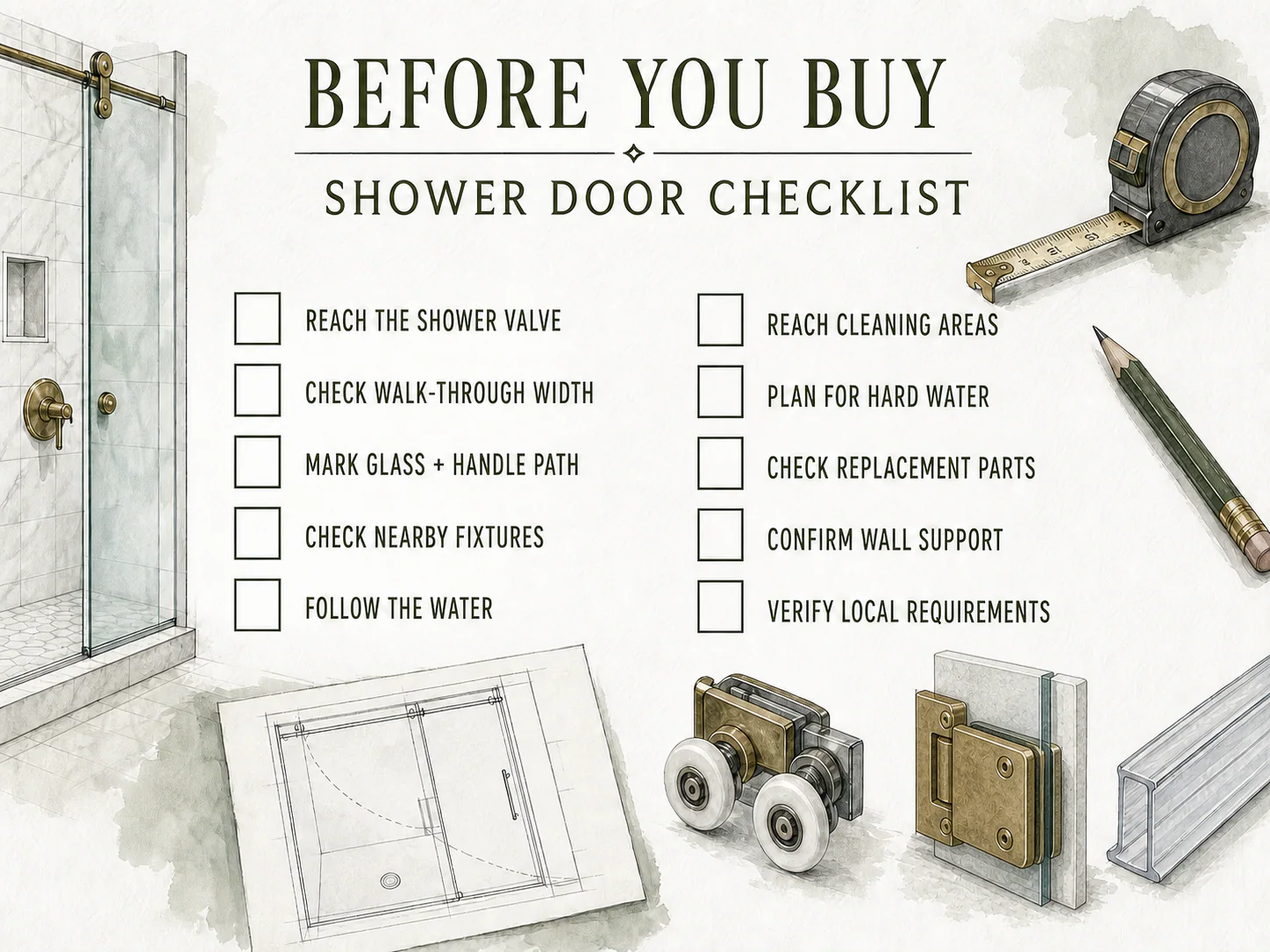
Print or save this list and check the room with the finished surfaces in place.
A sliding shower door is the stronger starting point when exterior swing space is tight, wet glass would open over a walkway, or access from either side of a tub matters. Before ordering, check the usable entry width and every area where the panels overlap.
A hinged shower door makes more sense when the room has a clear swing path and you value a direct entrance and easier access to the glass. Check where the wet panel will drip and whether the hinge wall has the required support.
Becky’s review shows the practical tradeoff. The door looked good and kept water inside during the shower, yet it still carried a little water outward when it opened.
The finish and glass may catch your eye first. Over the years, the entry, cleaning routine, and water on the floor will matter more.
No. Hinged doors are often a better fit when you want a direct entrance and easy access to the glass. Sliding doors usually work better when nearby fixtures leave no safe swing path. Use the measured layout to make the decision.
A simple frameless hinged door usually exposes more of the glass. Traditional bypass sliders may require more cleaning around tracks and overlapping panels. A modern top-hung slider with a small floor guide can narrow that difference.
No. Water leaking through a closed enclosure is different from water dripping off a wet panel after it swings outward. Closed-door leaks often involve seals, alignment, spray direction, the threshold, wall condition, or installation.
Sliding is usually the better starting point because it needs no exterior swing area. Still, check the model’s published walk-through width and which side opens. A door can save floor space and still leave an entrance that feels too narrow.
Both mechanisms cover a wide price range. Glass thickness, dimensions, finish, frame style, included panels, hardware, and installation requirements can affect price as much as the way the door opens. Compare equivalent configurations rather than category labels.
Based on Aurivedo’s internal data, tempered glass itself can last 20 to 30 years under normal conditions. The service life of the complete door depends more on the hardware and seals. Mid-range sliding shower doors typically last about 10 to 13 years. Rollers and tracks are the main wear points; sticking or noise becomes more common after 5 to 8 years, and replacing the rollers can often restore operation.
Mid-range hinged swing doors typically last about 12 to 16 years. They have fewer moving parts, and the main service items are seal strips and hinge screws. After about 6 to 8 years, the seals may need replacement and the screws may need tightening. Entry-level products often last about 5 to 8 years. Coastal conditions, hard water, and poor installation can shorten these ranges further. Seal strips and silicone are consumable maintenance items, so age-related leakage is a normal maintenance issue rather than automatic proof that the entire door has failed. These figures are internal planning estimates, not manufacturer guarantees for a specific product.
Use these with the exact product and room conditions behind your decision.
Your response helps us make the next guide more useful.
Loading responses…
Continue with the next decision in your bathroom project.