
A bathroom can look terrific in a photo and still leave you wedged beside the toilet trying to wash a child. For the shower door vs shower curtain decision, start with what happens in that room every day.
Keep a suitable curtain if you need room to reach across the tub, want a change you can undo easily, or prefer a smaller project. Choose glass if you want a rigid barrier and like the look, and the entrance, wall support, and upkeep work for you.
Work through space, water and cleaning, then the full bill. A closing glass door covers the entrance; a fixed screen leaves an open end. A curtain needs a layer that sends water back into the tub or shower base. That may be built in or supplied by a separate inner liner.

Glass Shower Door vs. Shower Curtain: Space and Everyday Use
Seeing the tile, stepping in, and reaching across the tub are different needs. Check each against your routine.
In a Small Bathroom, Check the Opening and the Door’s Path
Rule out a glass-door configuration if it blocks a necessary movement or the room cannot meet its mounting requirements. Get any missing entry or support detail from the drawing before ordering, so you know the door can serve the layout you have.
Glass lets your eyes travel into the shower. Your shoulders still have to get past the panels.
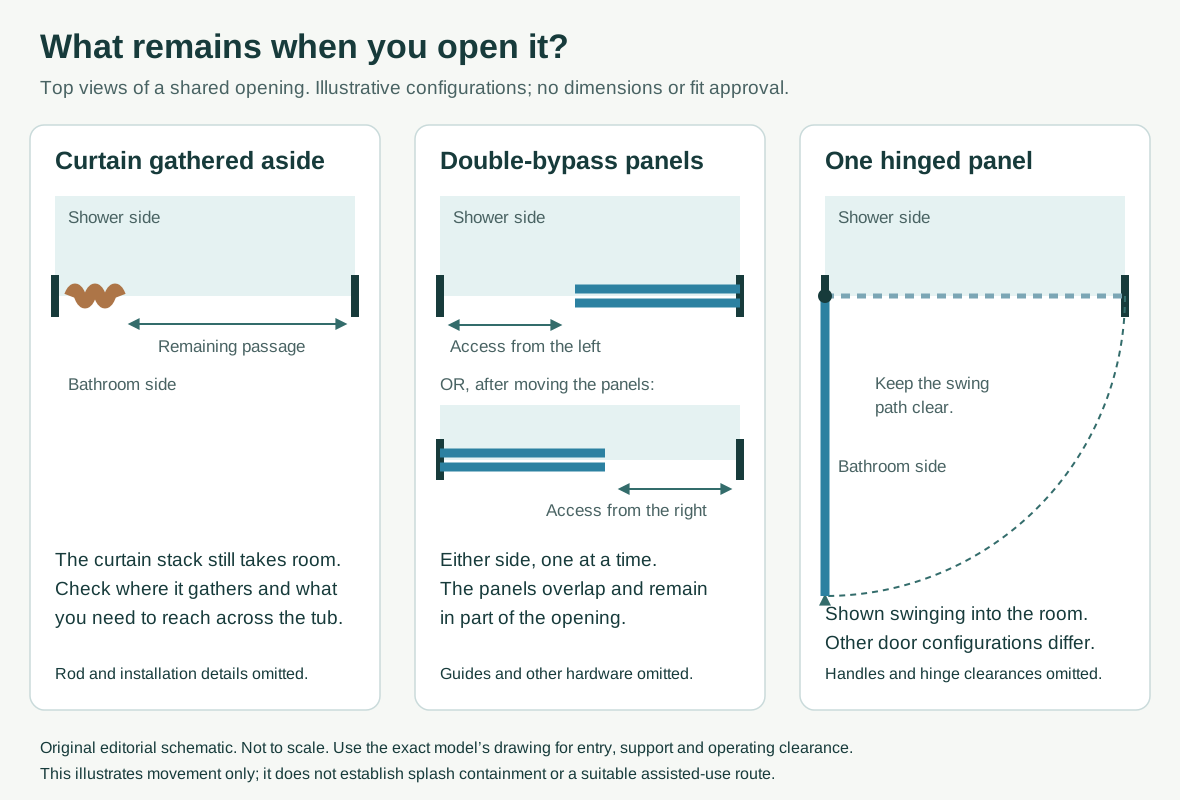
Bypass panels slide past each other like closet doors. They overlap, leaving glass across part of the opening even when you slide them aside.
A hinged door swings like a regular room door. If the toilet or vanity sits in its path, that swing will not work. You can still consider a different door arrangement.
Remember the handles, too. A panel clearing the vanity does not help if its handle hits it. Compare door movement and usable entry with the nearby fixtures included.
Compare the door fully open with the curtain gathered aside. Count what remains: glass, the rod, the bundle of fabric, and any guides. Guides are the small fittings that keep a sliding panel on its path. A curtain pushed aside still has to bunch up somewhere.
Start by measuring the finished opening, the gap between the completed wall surfaces. Then find the walk-through width: the space you can actually walk through with the door open. The advertised size and the usable entrance answer different questions. Keep both numbers.
Ask the seller, "For this model and my measured opening, how much space is left to walk through?" Check wall support, the threshold (the ledge beneath the door), and opening clearance in the matching instructions. Keep the model, measurements, and drawing together.
For glass doors on fiberglass shower walls, identify the shower unit and check the selected door’s required support. Missing support means pricing the wall work before buying. That changes the shopping list from "door" to "door plus work behind it."
For a Tub, Test the Reach You Need for Children and Other Tasks
For bathing children, a shower curtain can give you more working room when gathered aside. A glass door may leave panels or rim guides where you need to reach. For cleaning, compare removing the permitted fabric layers with reaching installed glass and hardware. Judge the actual layout, since door arrangements differ.
Imagine rinsing shampoo from a child’s hair near the far end of the tub. With the curtain gathered aside, where would you stand? Now put the proposed door into the same scene. Use its layout drawing or a showroom model to see where the opened panels would sit.
Some glass arrangements give you a choice of entry side. DreamLine describes Encore as allowing access from either side. Its two panels move to provide access at alternate ends, with overlapping glass remaining across part of the opening.
Run the same exercise for washing a dog, filling a baby bath, or scrubbing the far corner. Check any track or guide along the rim. The person taking a shower and the person leaning over to help may need quite different working space.
If the proposed glass gets in the way of an essential tub task, keep the curtain or change the door layout. If you mostly shower and the reach you need stays clear, extra tub access may matter much less to you.
For Older Adults or Assisted Bathing, Check the Person and the Task
Choose for the person using the bathroom. Watch the route in, the turn, the reach for the controls, and the move onto a seat. Include a helper’s standing space when needed. A birthday alone tells you very little about which enclosure will work.
The U.S. Access Board’s bathing-room guide requires enclosures in its covered shower configurations to leave controls and seat transfers unobstructed. Keep that access principle in mind. Its ADA dimensions apply within the guide’s scope, rather than serving as a sizing chart for every private bathroom.
A curtain can move aside for a helper or for getting onto and off a seat. Ordinary curtain rods, door handles, and glass panels are not grab bars. When someone needs support to sit or stand, specify grab bars designed and installed for that job separately from the enclosure.
Check the handle from the position in which the person will actually use it. Standing beside the tub and reaching from a shower seat are different tests. Work out the needed approach with the user and helper before deciding which end must open.
Read the chosen door’s handling warnings, too. It needs to fit both the room and the way the person can operate it.
Then enjoy the design choices. An opaque curtain can hide the tub when closed; clear glass puts the interior on display, including the shampoo bottles. In a shared bathroom, decide whether you want that view or would rather draw a curtain across it.
For privacy, check the actual coverage under your bathroom’s lighting. Look at the gaps and viewing angles. Frosted glass and an opaque curtain can screen a space differently, depending on what each covers.
Shower Door vs. Shower Curtain Pros and Cons: Water and Upkeep
You need a setup that catches the spray while showering, plus a cleanup routine you can live with afterward.
For a Walk-In Shower, Follow the Water Back to the Base
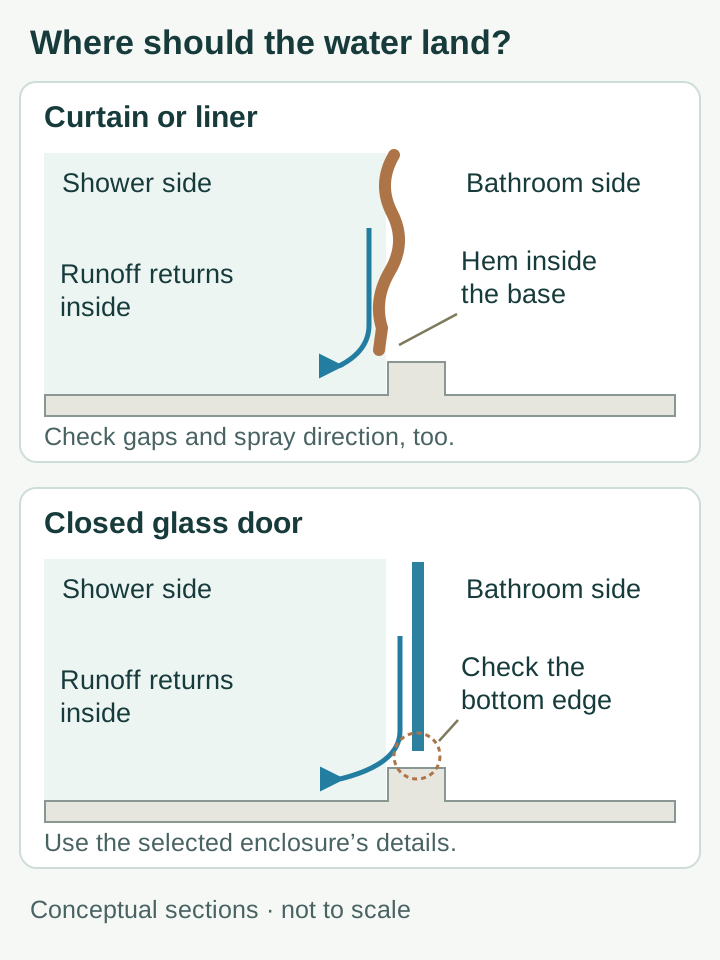
Watch where water goes after it hits the curtain or glass. Does it drip into the shower base, or head toward the bathroom floor? That is the difference you need to resolve before choosing a new barrier.
A suitable curtain or liner sends runoff into the wet area. Check its position and coverage while planning the rod. A pretty curtain is still doing a practical job: water needs to land inside the tub or base, with the spray path covered.
Glass has a straightforward advantage here: when closed, it stays in a defined position. A flexible curtain edge can shift or be left in the wrong place. Choose glass if that rigid barrier solves your problem, while still checking the seams and openings in the proposed enclosure.
Check the liner’s bottom, too. Some use weights or magnets to help keep it in place; IKEA’s NÄLK uses magnets as weights. Confirm whether they attach to your tub. Keep the liner correctly positioned even when it has that feature.
The National Glass Association’s frameless enclosure manual says frameless enclosures are not watertight and identifies gaps between and beneath sliding panels as escape paths. For those configurations, check panel position and spray direction along with the glass.
Water through a seam during the shower, spray through an open entrance, and drips from a wet door opening onto the floor take different routes. Identify which problem you need to solve.
For a fixed screen with an open entrance, include the open end in that check. Confirm spray direction, coverage, and where runoff lands. A failed base or waterproofing assembly needs its own repair; changing the curtain or door will not do that job.
With a shallow base, use the curtain and base instructions to check where the rod places the water-catching layer. Decorative length alone does not settle that. If runoff would land outside, change the arrangement before use.
Separate Comfort During the Shower from Drying Afterward
A draft does not care what you paid for the enclosure. Look at the height, open ends, and gaps that expose you to moving air while showering.
NOAA explains that evaporation absorbs energy, including energy from body heat. That helps explain cooling at wet skin. It gives you a reason to consider air exposure, rather than a temperature ranking of doors and curtains.
NGA notes that an open splash panel may hold heat less well than a full enclosure. So compare how enclosed the actual shower is. Find the opening that lets a draft reach you; swapping one material for another while leaving that opening may miss the point.
Once you turn the water off, the job changes. Wet surfaces need to dry, and the bathroom needs to lose that moisture. Check ventilation and the product’s after-use instructions separately from how cozy the shower feels while you are in it.
Compare the Care You Can Actually Reach and Repeat
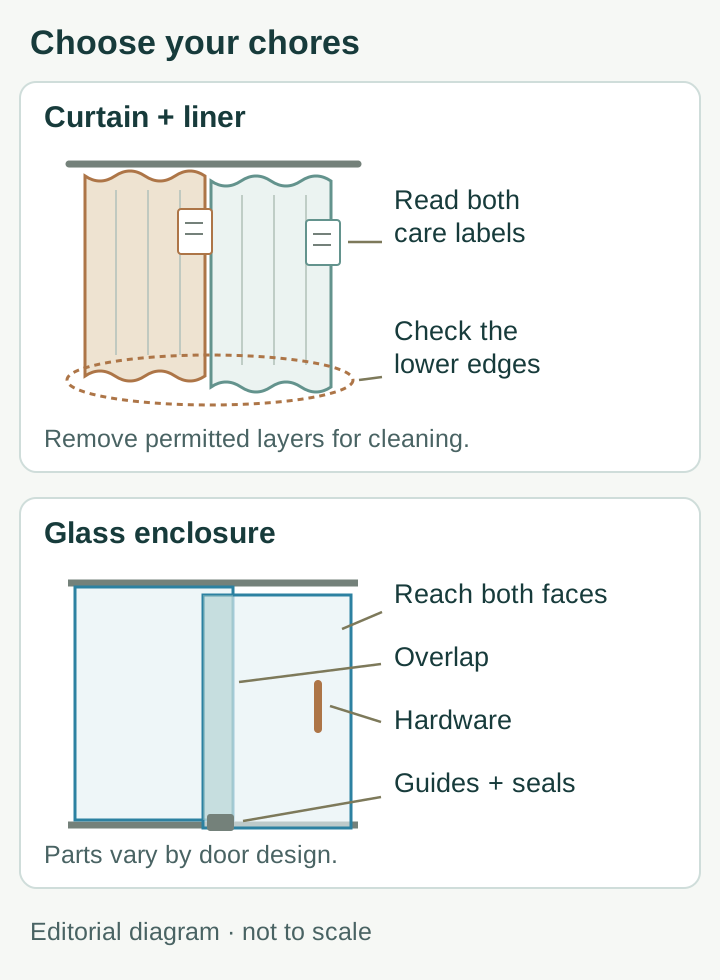
Choose your chores. Curtain care may mean taking layers down, following their labels, drying them, and rehanging them. Glass stays put, so you need to reach both faces, overlaps, guides, hardware, and seals. Neither choice gets a free pass on housework.
If you would rather do laundry than clean an installed enclosure, look for a curtain whose label allows it. IKEA’s BORSTALOE polyester curtain, for example, permits warm machine washing on a durable-press cycle and calls for line drying.
The NÄLK polyethylene liner’s label says "Do not wash." Read outer-curtain and liner labels separately before putting both in the same laundry plan.
Glass has a maintenance routine, too. The Encore family’s Ver 2b 102023 manual, maintenance page 21, calls for wiping glass and metal after use and inspecting them periodically. For your door, follow its own glass-treatment, finish, and hardware instructions.
Before buying, make sure you can reach both panel faces and the overlap comfortably. The attractive corner you cannot reach will still need cleaning. Match any treatment to the glass, finish, and surrounding materials; the separate guide to hard-water care for shower glass covers existing deposits.
For mold, tackle the moisture. EPA identifies moisture control as the way to control indoor mold growth, including water problems and ventilation. Keep doing that work whichever enclosure you buy. A new door or a freshly washed curtain cannot take over the bathroom fan’s job.
Shower Door vs. Shower Curtain Cost: What You Actually Pay
Compare the whole shopping cart. Reusing a suitable curtain rod and installing a glass door that needs wall work involve different purchases and different labor. The price tag on one item will not tell you the cost of finishing the room.
Compare Complete Project Scopes Before Comparing Prices
Use the table like a checklist for two complete quotes. Mark each line included, not needed, reusable, or separately priced. Put delivery and applicable taxes on the same basis for both, counting only the work your bathroom needs.
| Cost item | Curtain setup | Glass-door setup |
|---|---|---|
| Barrier and components | Curtain, separate liner if required, rod, rings | Glass panels, specified hardware, seals |
| Mounting preparation | Compatible surfaces and any required fixings | Required wall support and threshold preparation |
| Installation | Any paid labor; record your own time separately | Quoted labor and installation exclusions |
| Purchase and delivery | Delivery and applicable taxes, if not included | Delivery and applicable taxes, if not included |
| Removing the old setup | Removal, disposal, and any finish repair | Removal, disposal, and any finish repair |
| Ongoing work | Permitted care and actual compatible replacements | Permitted care and actual parts or service |
Ask, "Is this the complete door kit, or are glass, hardware, or seals extra?" Then settle support work, old-unit removal, and patching with the installer. For the curtain option, check that the rod and rings you plan to keep really fit.
Leave missing costs marked unknown until the work is clear. If wall support or finish repairs are excluded, the door quote is incomplete for your project. Put optional new trim on a separate line so a design upgrade does not look like a required installation cost.
Long-term cost depends on what you actually replace, repair, and pay to maintain. Keep your own cleaning time separate from cash costs. Compare dated quotes with matching inclusions, then decide whether the result is worth the price and upkeep.
Check What Can Be Replaced—and What Leaves Work Behind
If you expect to move or change the room again, favor a setup you can undo easily. IKEA’s HORNEN rod uses a spring mechanism without screws or drilling. Check the actual rod’s span, surfaces, and any permission needed for changes.
Tension rods need the right surfaces and adjustment. Fixed rods need the wall mounting their instructions specify: Moen’s instructions distinguish drywall anchors from screws into studs. Check span and load limits with the curtain and liner in mind, including their weight when wet.
With glass, allow for taking out fixings and sealant and repairing finishes if you remove it later. Ask which parts you can replace individually. A diagram can show you a roller or seal; it cannot promise a matching replacement will be available when you need one.
Keep fixed lifespans out of the savings calculation and read actual warranty terms separately. Curtain replacements still need to fit. If glass is chipped or damaged, stop using it: Delta’s safety guidance says not to use a damaged panel.
Buy the look and function you want. Do not build the budget around a promised resale payoff or an environmental winner without suitable evidence for that comparison.
Keep the Curtain, Choose Glass, or Resolve the Deciding Check
Keep a suitable curtain when broad tub reach, an easy change to reverse, or a smaller initial job matters most. If the planned curtain cannot give you the water coverage or operation you need, change that setup before relying on it.
Replacing a curtain with glass makes practical sense when you want a steady barrier and a clear view into the shower, and the door’s entrance, mounting, and care requirements fit your room and routine. If those checks pass and you prefer the look, choose the glass.
Missing an entry dimension? Get the model’s opening drawing before ordering. Resolve essential access or mounting gaps first; once both options work, choose by routine and complete price.
Can I use a glass door and a curtain together?
Yes, if you can still open the door and get out easily. A curtain in front adds one more layer to move when entering, so check both layers in their open and closed positions. Leave the door’s swing and handle clear.
Give the curtain its own support. Do not hang an improvised load from door hardware. Any new mounting must suit the product and wall, and its hardware must stay out of the door’s path. Check both supports as one layout before adding the curtain.
Prepared with AI assistance using manufacturer documents, industry guidance, and an Aurivedo customer remodel.
Sources and project notes
Product documents and guidance used for this comparison, with the scope of each reference.
- Door movement and usable entryOperating paths, panel overlap, and usable entry.
- Finished-opening measurementFinished-opening measurements and exact-model fit checks.
- Glass doors on fiberglass shower wallsIdentifying the shower unit and checking required mounting support.
- DreamLine Encore SHDR-1660580-01The named Encore product’s alternate-side bypass access.
- U.S. Access Board: Bathing RoomsEnclosure, controls, and seat access within the guide’s covered configurations.
- NGA 2023 frameless enclosure manualPrinted pages 8 and 20–21: water escape paths and open-panel versus full-enclosure layouts.
- Fixed screen and open entrancePlanning around a fixed screen and an open entrance.
- NOAA: The water cycleEvaporation can draw energy from body heat.
- IKEA BORSTALOE 106.055.65 care labelThe named polyester curtain’s warm durable-press machine-wash and line-dry instructions.
- IKEA NÄLK 006.264.98 care labelThe named liner’s bottom magnets, their weighting role, and its own care label.
- Encore manual Ver 2b 102023Printed p. 21/PDF p. 23: glass and metal care and periodic inspection in this manual version.
- Hard-water care for shower glassMaterial-compatible care for existing deposits.
- EPA: Ten Things You Should Know about MoldMoisture control, water problems, and bathroom ventilation.
- IKEA HORNEN 703.148.89The named spring-operated rod’s no-drill mechanism.
- Delta shower-door glass safetyStop-use guidance for chipped or damaged glass.
- Moen fixed curved-rod installation instructionsDrywall-anchor and wood-stud fastening methods in the named curved-rod instructions.
- Customer remodel photographs and accountSupplied by Aurivedo’s publisher. The homeowner followed our recommendation and preferred frameless glass for its modern appearance. The photos show a broader tub-to-shower remodel; no performance test or usage follow-up is claimed.