
You’re looking at a shower door and a faint corner mark, wondering: are shower doors tempered glass? Modern U.S. residential shower doors commonly use tempered safety glass; to identify your own panel, start with its mark and door records.
Use the mark to check the stated glass type and the full model to find its documents. Confirm missing details before ordering a replacement.
Two-minute check
-
Keep the glass in place. Photograph the full door, then the complete corner mark on each accessible panel.
-
Look for “TEMPERED GLASS.” That answers the basic labeling question; it doesn’t confirm the panel’s condition or replacement fit.
-
Mark unclear characters as uncertain. Send photos to the brand, original seller, or installer and ask for help identifying the glass.
-
Ordering replacement glass? Continue through the model, marking, and product-document checks below.
Shower Door Safety Glass Requirements: The Direct Answer
When checking shower door safety glass requirements, look for the glass type and its safety documentation. “Tempered” describes the construction. The standard and category tell you which safety requirements the supplier says it meets.
Does Shower Glass Need to Be Tempered?
It must be safety glass. Tempered glass is the usual choice for modern U.S. shower doors. Tempering is not the only qualifying construction: a laminated alternative needs documented safety performance and door-system compatibility. Ordinary unprotected annealed glass is not an acceptable substitute.
For example, Delta’s glass-safety guide specifies tempered glass for its shower doors. Check the documents for your own door to confirm its construction.
Q: What safety-glass construction is commonly used in modern shower doors?
Tempered safety glass is commonly used. Before buying, check that model’s glass description, then compare it with the identification on the delivered panel. For a laminated product, confirm its full construction, documented safety performance, and intended door system.
16 CFR Part 1201 expressly covers shower doors and enclosures; §1201.2(a)(4) places them in Category II. This is a safety-performance requirement, not permission to substitute ordinary annealed glass without the required performance. It also does not replace the installation requirements applying to your project.
Ask for the glass type and safety documents. List construction, standard, and category separately to spot omissions when the glass arrives.
Tempered and Laminated Describe Different Properties
If your mark clearly says “TEMPERED GLASS,” you can skip this distinction for basic identification. It matters when a quote or document says “laminated” or “heat-treated.”
Tempered describes a specific heat treatment; laminated means layers bonded through an interlayer. A laminate can contain tempered glass, so the words can overlap. Guardian explains this construction. Ask for the full construction when a quote says only “safety glass” or “laminated.”
Also check what a supplier means by “heat-treated.” The Safety Glazing Certification Council (SGCC) runs a voluntary certification program. Its FAQ distinguishes heat-strengthened glass from tempered safety glass, so keep the complete treatment description on the quote; these terms aren’t interchangeable.
Heat-strengthened glass on its own is not safety glazing for a shower enclosure. Do not accept a bare heat-strengthened sheet as the door panel. Laminated glass can contain heat-strengthened plies; for that construction, require evidence that the complete laminate meets Category II impact requirements and matches the door system.
For privacy and appearance, compare clear, frosted, and other shower-glass options. Those finishes describe how the glass looks. You still need the construction and safety documents to check its specification.
Can Tempered Shower Glass Be Cut?
No. Do not trim a finished tempered shower panel to fit an opening. The Commix installation guide, page 3, explicitly warns against cutting tempered glass or touching its edges with tools because it may shatter.
If someone proposes trimming the panel or adding a hole, request a correctly specified replacement through the supplier. Resolve the required dimensions and hole pattern through the product’s ordering process before accepting the replacement.
Check for damage, too. Delta says not to use a chipped or apparently damaged panel, or install damaged glass. Contact the brand about replacement even if the safety mark is perfectly readable.
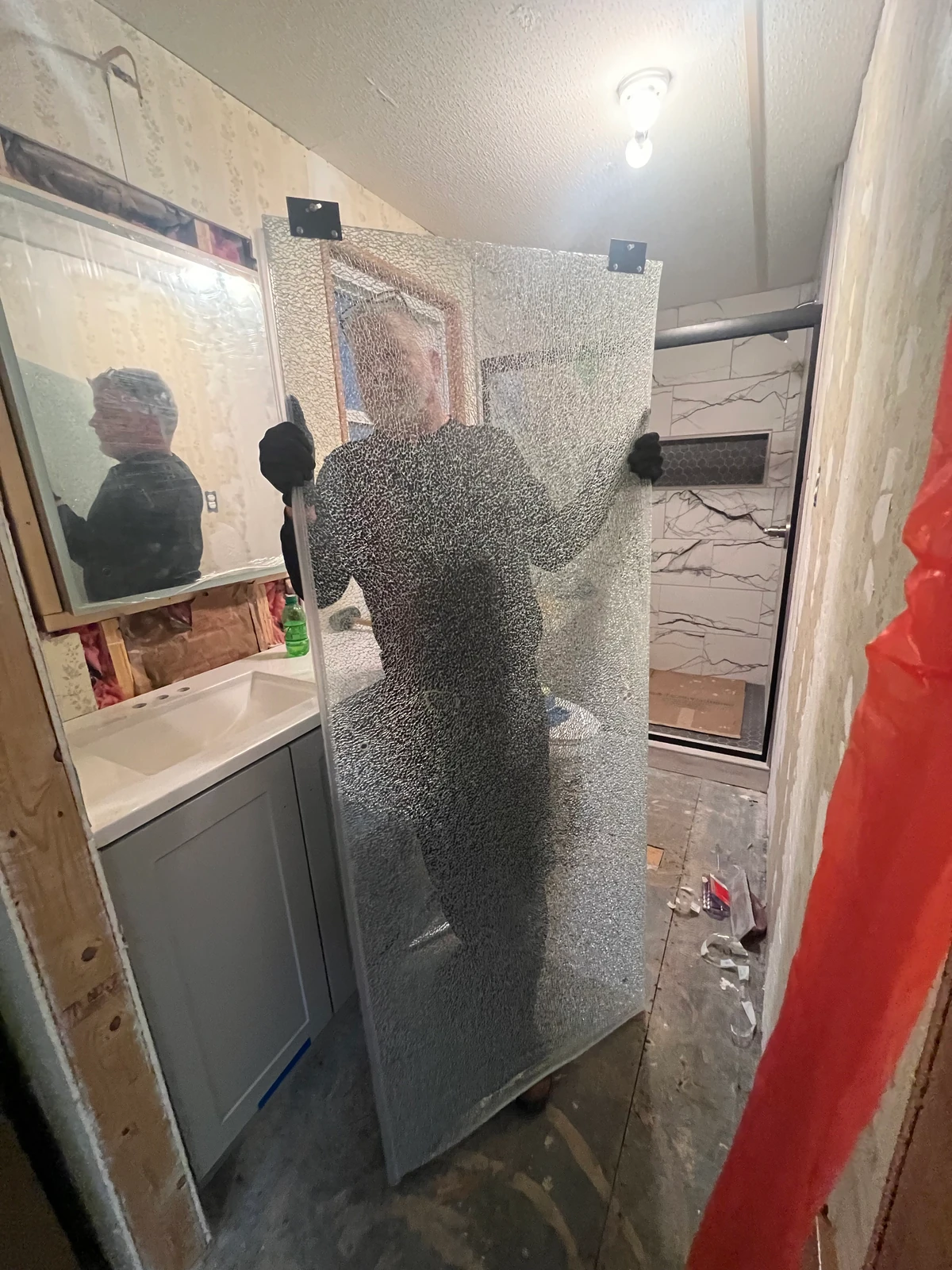
Real after-sales example
Tempered does not mean unbreakable. This photo comes from our own after-sales work: a tempered shower panel was damaged in transit. The specific trigger for breakage remains unknown.
How to Tell If Shower Door Glass Is Tempered
To work out how to tell if shower door glass is tempered, photograph the glass mark and find the complete door model. The mark describes the panel; the model leads you to the product documents.
Find and Record the Visible Mark
“How do I know if my shower door is tempered glass?” Start at the accessible corners. Leave the panel in place and photograph the whole mark, including faint letters, numbers, and a little surrounding glass.
Take a wider photo showing which panel you’re recording, then a close photo of the full lettering. Copy it line by line, marking unclear characters as uncertain rather than filling them in from memory.
Photograph each accessible panel mark separately. Label the photos with a location, such as “fixed panel beside the wall,” so the person helping you knows which pane you mean.
The federal definition of a permanent label in §1201.2(a)(22) includes sandblasting, acid etching, and destructible polyester labels. Look for more than laser-etched lettering, and don’t peel a label to test whether it is permanent.
Weight, tint, reflections, and polarized patterns don’t provide a standard, category, or matching product identity for this document check. Keep the glass in place; you don’t need to scratch, tap, or break it to collect the information.
Find the Complete Door Model Separately
The glass fabricator processes the glass; the retail brand sells the door. Think of a tire maker and a car brand: identifying the tire maker alone won’t tell you which car it fits. Likewise, the glass number alone cannot select a replacement panel.

Q: Where can a homeowner find the complete shower-door model when the glass mark identifies a fabricator?
Check the packaging and the manufacturer’s identification instructions first. Delta’s Commix product-page FAQ points to the model above the box’s UPC and the track-system name on most guide covers. A track-system name can help narrow the search without supplying a complete model.
KOHLER’s model-location guide lists brand-specific locations: a sliding-door label may be inside or underneath the header, the top rail. Some pivot-door labels sit behind hardware; minimalist frameless models may use a supplied pamphlet. Check paperwork or contact support if reaching the label would require dismantling.
Copy the brand and complete model, including every dash and suffix. Keep the selected size and finish with it, and photograph the label or paperwork. A family name narrows your search; the full model identifies the selected product.
Without the box, collect invoices, installer records, and parts correspondence. If you don’t know the brand or model, send the original seller or installer a full-door photo, accessible labels, and any partial identifiers. Ask them to identify the complete model first, since a familiar handle isn’t enough to choose a replacement.
Shower Door Safety Markings: Read the Fields and Check the Record
Read shower door safety markings one field at a time: material, standard, category, thickness, and certification number. Compare each with the documents rather than stopping at the first matching number.
Read the Material, Standard and Category Fields
Quick check: A clear “TEMPERED GLASS” mark gives the basic answer: the panel is labeled tempered. You can stop the identification reading here. Continue below to check the supporting safety records or order replacement glass; the label alone cannot establish condition or fit.
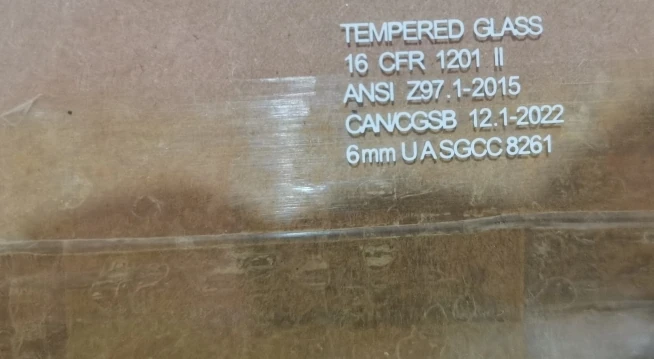
Example A is an existing Aurivedo factory-sample photo showing 6mm and SGCC 8261. Its photographer and retail-door model remain unconfirmed; use it to practice reading, not identify another door.
Copy every visible line, even without supporting documents. Keep “printed on the glass” separate from “matched to this document”: observing a claim and checking its support are different steps.
The table copies the existing mark photograph. The SGCC label requirements and directory key explain the fields; the next subsection shows the dated record comparison.

| Visible field | Meaning | Dated comparison | Still unresolved |
|---|---|---|---|
| TEMPERED GLASS | Material designation | TTG entry agrees | Individual pane provenance |
| 16 CFR 1201 II | U.S. standard and category | Listed COMPOSITE scope | Connection to this pane |
| ANSI Z97.1-2015 | Referenced safety standard | Listed COMPOSITE scope | Supporting record scope |
| CAN/CGSB 12.1-2022 | Additional standard reference | Not independently matched here | Separate certification evidence |
| 6mm | Stated size, called nominal thickness | 6.0mm entry agrees | Exact retail product |
| U A SGCC 8261 | Size category, impact class, certification number | U / A / 8261 agree | Complete door identity |
In this program, U means the unlimited size category; A identifies the ANSI 48-inch drop class, not a quality grade. Neither authorizes an unlimited door width or hinge load, so check the actual door specification separately from those certification letters.
SGCC’s program is voluntary, so a missing SGCC number alone doesn’t settle compliance. If a readable mark names another program, check that program’s records. You can also ask the manufacturer for documents matching the glass and standard shown.
Under the cited SGCC label revision, laminated labels need not include thickness. Other layouts can be valid; compare their fields with the relevant program’s rules.
Match the Number to a Dated Fabricator Record
Open the public SGCC PDF directory; no account is needed. Press Ctrl+F on Windows or Command+F on a Mac and type the complete SGCC number. On a phone, use the PDF viewer’s search or magnifying-glass control. Search the document rather than scrolling page by page.
Save the matching manufacturer row with the directory date, then compare the construction, thickness, and categories. If you can’t find a clear match, ask SGCC or the supplier for help.
You can also send clear photos of the mark to the door brand’s customer service and ask for help reading it and finding the records. If you don’t know the brand, start with the original seller or installer. They may need more details.

Q: How do the fields on a shower-glass safety marking relate to its supporting documents?
Match the identifier, construction, thickness, and certification scope field by field. The July 2026 SGCC directory, PDF page 89, lists 8261 under Foshan Nanhai Nengyang Electrical Technology Co., Ltd., with 6.0mm, TTG, U, and A. Its key defines TTG as tempered transparent glass.
The row says COMPOSITE, which SGCC defines as ANSI Z97.1 / CPSC 16 CFR 1201 testing. COMP+CAN also includes CAN/CGSB. That explains the U.S. standards listed here, but doesn’t separately support the Canadian line in the photo.
Example A’s fields agree with the July 2026 entry. The Canadian line, current online certificate, and connection to a retail door remain unconfirmed. Keep those open questions beside the match: the dated entry cannot authenticate this individual pane.
The SGCC consumer FAQ explains how the number points to a glass product and manufacturing plant. Put that name under “glass fabricator,” keeping the retail brand and complete door model in their own entry.
Keep Glass Identity Separate from Door-System Suitability
Before ordering, match the replacement pane to your exact door system’s glass specification and hardware arrangement. Use the system’s documents or written supplier confirmation. Knowing that a panel is tempered doesn’t tell you whether it fits your door.
The Commix guide, page 3, requires gaskets and bushings between glass and metal. These pads and sleeves keep the two apart, but the glass mark cannot show whether the installed hardware follows those instructions.
Get written confirmation of the replacement panel or part and the door model it fits. Ask which gaskets, bushings, seals, or hardware that replacement needs. Check what comes in the shipment and what the manufacturer allows you to reuse.
For more on thickness, compare shower-door glass thickness. Write a precise result, such as “the photographed fields match this dated record.” Before approving a replacement, also confirm that the panel matches the door model.
Shower Door Safety Markings and Product Specs: Complete the Check
Use the full model to find the glass description and manual. Check one version at a time and whether its documents identify the proposed pane.
Match One Door Model to Its Own Product Page and Manual
Example B uses the Delta Commix 8mm product page. When checked on October 18, 2026, the selected version was SDES848-PC-R: 48-inch Shower, Clear glass, Polished Chrome. Here, 48 inches describes the complete system, not one pane’s width. This example is separate from the 6mm photo in Example A.
Save the selected version, page address, and date; pages can reopen to another option. These details let someone return to the exact product without restarting from the family name.
The page describes 5/16-inch (8mm) certified tempered glass and directly links a Commix installation guide. The linked PDF’s cover names the Commix exposed-roller shower door, identifies 8mm glass, and carries a December 2019 date.
| Record | Observed information | What it supports |
|---|---|---|
| Selected product | SDES848-PC-R; 48-inch; Clear; Polished Chrome | Identity of the retrieved selection |
| Glass description | 5/16-inch / 8mm certified tempered glass | Published construction and nominal thickness |
| Directly linked guide | Commix exposed-roller; 8mm; December 2019 | Product-family document connection |
| Delivered-panel connection | No delivered pane or matching identification records examined | No delivered-panel identity established |
The page and manual identify a product and its published glass specification. They don’t name the fabricator of a delivered pane. Example A’s unrelated 8261 photo cannot supply that missing connection for this Delta model.
Keep the manual’s December 2019 cover date in your notes. Although the product page currently links to it, a family guide doesn’t identify a delivered pane or prove which revision applies to every shipment. When ordering parts, confirm the documents for the unit supplied.
No Stamp or Conflicting Records: What Can You Conclude?
If you can’t find a mark, this check hasn’t identified the panel. That doesn’t prove it is ordinary annealed glass or an unlawful installation. Note where you looked and what you couldn’t find, so you can explain the gap when asking for help.
An older unmarked panel could be annealed; it may also predate the federal standard’s general July 6, 1977 effective date. A home’s age doesn’t date its glass. If records are unavailable, have a glass professional assess the panel and replacement options.
Q: When is the available information insufficient to confirm a shower panel’s identity and suitability?
You need more information if the mark is unreadable, the product is unidentified, or the records disagree. Ask for the missing piece: a clearer photo, the complete model, or a document connecting the proposed panel to that model.
| State | Conclusion | Next action |
|---|---|---|
| Relevant fields agree | Records consistently describe the glass construction | Record that result; check replacement fit separately |
| Evidence is missing | Identity or replacement fit remains unresolved | Request the missing record; hold the affected replacement order |
| Relevant records conflict | The disputed claim has not passed the check | Hold purchase approval and request an explanation |
If a quote specifies 8mm glass but the photographed mark says 6mm, ask which item each record describes before approving the order. This hypothetical mismatch doesn’t connect Examples A and B, and it doesn’t establish mislabeling.
The reply should identify which item was quoted, explain the difference, and name the supporting document. Save it with the quote and note which question it resolves. If your existing glass is damaged, follow the manufacturer’s instructions above.
For a known model, ask, “Which record connects this replacement panel to my complete door model?” If nobody can identify the model, ask a shower-door installer to assess replacement options from the actual enclosure. Keep the replacement order on hold until its identity and fit are resolved.
Record the Result Before Buying or Replacing Glass
Keep photos, glass documents, and the model together: they show the mark, documented construction, and exact door. Save each beside the question it answers.
Copy this table into your notes. Keep glass and complete-door entries separate, even with one supplier, and record what is confirmed and what to ask next.
| Record field | Your entry |
|---|---|
| Glass mark / photo | ___ |
| Documented glass construction | ___ |
| Standard / category evidence | ___ |
| Complete model / variant | ___ |
| Source and check date | ___ |
| Unresolved item and recipient | ___ |
| Limited result / next request | ___ |
A hypothetical note might read: “Mark says tempered; the model document also specifies tempered glass. Replacement fit is unresolved; ask the seller to match the panel or part to this model.” You have an answer about glass type; leave the purchase open until fit is checked.
Date the result and keep the supplier’s reply with your question. If the proposed panel or model changes, recheck the affected fields; the earlier comparison belongs to the original item.
For a full custom order, use the custom shower-door order checklist. When replacing the entire door, measure the finished shower opening. For one pane, use the matching replacement specification or approved glass drawing; don’t calculate its order size from the opening alone.
Sources and citation notes
The recording workflow, hypothetical mismatch, and three-state outcome table are editorial synthesis from those evidence boundaries. They are not attributed homeowner experiences, laboratory findings, or certification-body decisions. The cover is an AI-generated editorial illustration; its sample marking is illustrative, separate from the actual photographs below.
- 16 CFR Part 1201 — architectural glazing safetySupports the shower-enclosure scope, Category II classification, permanent-label definition, and general effective date in sections 1.1, 2.1, and 4.2. Accessed October 18, 2026; the page displayed Title 16 current through October 15. No project-specific local-code assessment is claimed.
- Delta glass-safety and installation guidanceSupports the Delta construction example and its damaged-glass instructions in 1.1 and 1.3. Accessed October 18, 2026; brand statements are not a market-share survey or an inspection of the reader's panel.
- Guardian laminated-glass constructionSupports the distinction between heat treatment and layered construction, including tempered or heat-strengthened plies, in 1.2. Used for construction principles, not approval of a particular shower product. Accessed October 18, 2026.
- Delta Commix installation guidePDF cover and page 3 support the family/glass description, date, cutting restriction, and glass-to-metal separation in 1.3, 3.3, and 4.1. Cover dated December 2019; directly linked from the product page on October 18, 2026.
- Delta Commix 8mm product pageSupports the observed selection SDES848-PC-R, published glass description, linked manual, and box/guide identification advice in 2.2 and 4.1. Accessed October 18, 2026; no certificate or physical product was supplied for this example.
- KOHLER shower-door model identificationSupports brand-specific model-label and paperwork locations in 2.2. Accessed October 18, 2026; hidden locations do not constitute instructions to dismantle a door.
- SGCC consumer FAQSupports the heat-strengthened/tempered distinction and use of marking numbers to investigate manufacturing identity in 1.2 and 3.2. Accessed October 18, 2026. No current plant certificate was obtained for Example A.
- SGCC label requirementsSupports the label-field interpretation and laminated-label thickness exception in 3.1. The retrieved document is revised July 1, 2024; these are SGCC program rules, not a universal label template.
- SGCC Certified Products DirectoryJuly 2026 edition, PDF pages 89 and 115, supports the dated 8261 comparison and code interpretation in 3.1–3.2. This is a dated directory comparison with explicitly unresolved fields, not live certification of an installed door.
- Aurivedo's existing factory-sample mark photographSupports only the visible transcription in Example A. Existing source notes record photo supply on September 24, 2026; photographer, manufacture date, and retail-model relationship remain unconfirmed. No new photography, installation test, or expert review is claimed.
- SGCC Get CertifiedDefines Composite and COMP+CAN testing terminology used in section 3.2. Checked October 18, 2026. The definition explains a directory field; it does not authenticate an individual pane.
- Photograph from our own after-sales workSupplied October 18, 2026. The publisher confirmed that this photograph comes from its own after-sales work and that the tempered panel was damaged in transit. The photograph shows the fractured condition; the transit history comes from the publisher, not a visual diagnosis. The specific breakage trigger, service outcome and product model are unconfirmed. This case is separate from Examples A and B. No claim is made that Sam photographed or personally handled it.

