

Black grid shower doors bring a windowpane look to the bathroom, with printed lines or an added grid. The look is easy to fall for. Living with it takes a few more questions, especially if you’d like some privacy and prefer cleaning without putting your squeegee through an obstacle course.
Clear glass stays see-through between the black lines. If someone else may be in the bathroom while you shower, look for obscuring glass or a privacy treatment. For cleaning, find out whether those handsome lines are printed on the pane or stand proud of it. A photograph can make both look much the same.
Start with the glass. Then put the pattern back into your own bathroom, with its window, lights, and tile. Once you like the view, check how the door opens, where your cleaning tools can reach, and what the seller will put in writing before you order.
Black grid shower door privacy: choose the glass first
For black grid shower door privacy, start with the glass description on the order. KOHLER’s U.S. shower-door catalog lists clear, frosted, and frosted privacy-band glass. Those are useful options to ask about, but check which glass and grid combinations your chosen model actually offers.
Are black grid shower doors private?
Think of clear black grid shower doors as a window with mullions: the bars frame the view, and the gaps let you see through. The lines hide only what they cover, so clear glass won’t give you reliable privacy screening.
Coastal’s Gridscape 1 door with an inline panel lists clear and obscure glass. HMI’s grid system also lists an optional printed privacy shield. These are separate choices alongside the grid, so get the glass or privacy treatment named on the specification.
In a shared bathroom, decide what another person should be able to see before choosing the pattern. A grid can outline the shower while leaving the person inside visible through the clear spaces.
You can also ask about screening just part of the enclosure. HMI’s Priva-Tech system lets you specify the printed area and its transition. Have the supplier draw that area on the actual shower elevation, so you can see where the privacy band starts and stops before approving it.
Check the fixed side panels as well as the door. A screened front won’t help much if the panel beside it leaves a clear view from the doorway. Work out which views need covering first, then ask how the pattern will carry across the whole enclosure.
| Glass choice | What to evaluate |
|---|---|
| Clear | Accepting visible shower interiors and clear sightlines. |
| Obscure or frosted | Detail and silhouette visibility in the actual lighting. |
| Partial privacy print | Coverage across the door and any exposed side panels. |
Picture someone brushing their teeth while another person showers. Check the view from the sink as well as the entrance. If you use the bathroom alone, clear glass may suit you and keep the tile visible. Choose around how the room is shared.
Check a privacy sample from the doorway
Give the glass a small audition before ordering. View a sample or showroom enclosure from roughly the distance of your bathroom doorway. Turn on the shower lighting and look for details: can you make them out clearly, or do you see only a silhouette?
A sample is a useful buying check, with limits. It can’t reproduce the full enclosure, your lighting, or the distance between a person and the glass. If it reveals more than you’d like, ask to see another privacy option.
Keep the background and viewing position the same when comparing samples. Put the same patterned card or colored towel behind each one. Nobody needs to volunteer as the showroom’s shower model, and you’ll have a consistent object to judge.
Have the privacy band’s top and bottom edges marked on the drawing. Check them against the user’s height and viewing positions outside the shower. Approve a defined coverage area; “privacy glass” alone leaves too much to the imagination.
Customer example: keeping the wall in view
One customer worried that a black grid would make the shower feel boxed in and hide the marble-pattern wall. After comparing frosted-glass designs, they chose the clear-glass sliding enclosure shown below. The pattern was meant to frame the view, not become the view.
After installation, the customer felt the result exceeded their expectations. Through the clear spaces, the wall pattern and black shower fixtures remained visible. Keeping those details on display—and preserving an open feel—was the main reason for the final choice.
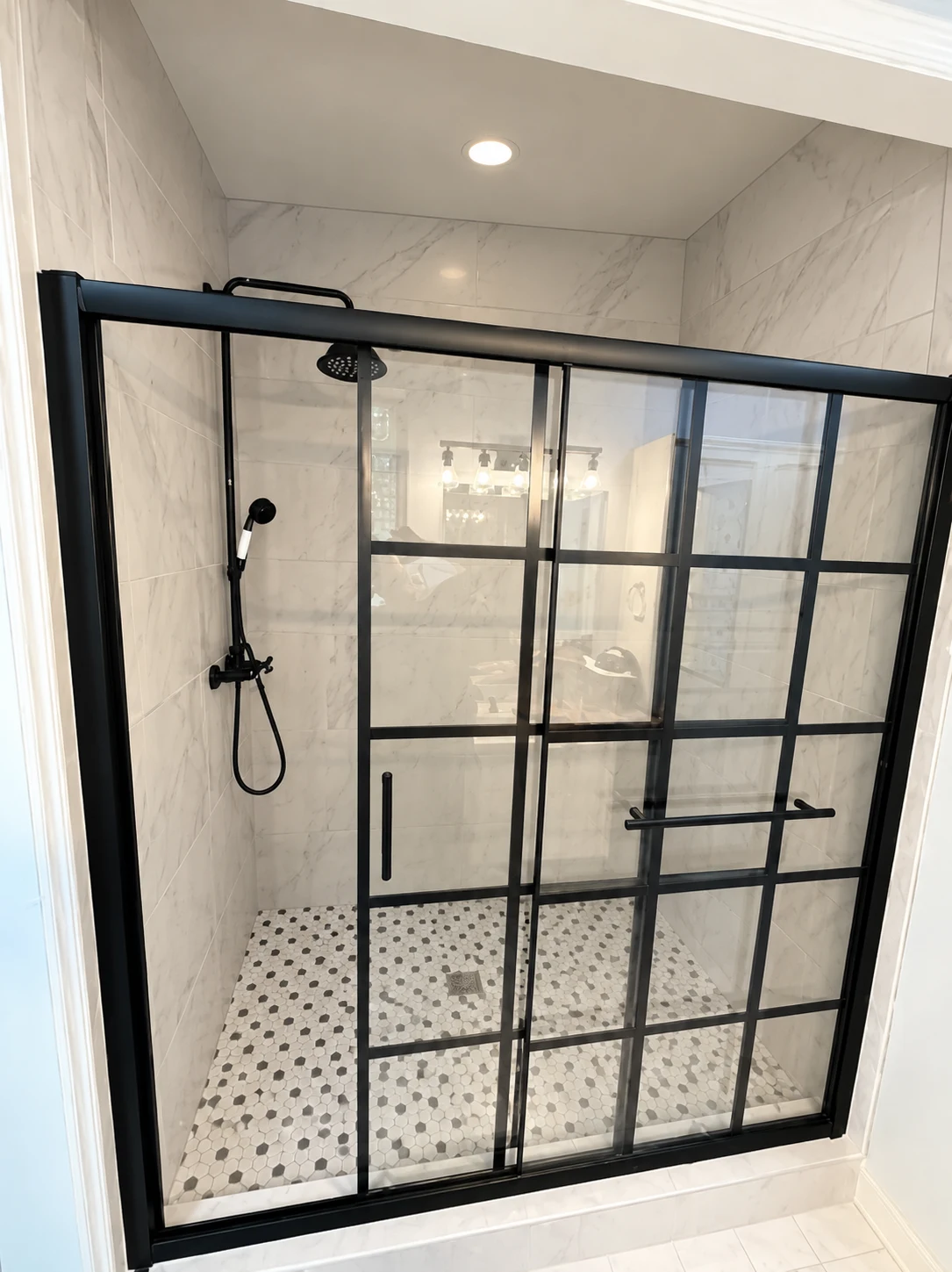
Customer photo: The tile and shower fixtures remain visible between the black lines. This installed example shows the open view you get with clear glass.
Black grid shower doors in small bathrooms: light and sightlines
With black grid shower doors in small bathrooms, an open view and a bright shower are separate questions. Clear glass keeps the tile visible, while the grid adds a pattern. Neither tells you how much light reaches the shower.
Do black grid shower doors block light?
Opaque lines block light where they cover the panel; uncovered glass lets it through. The result depends on grid coverage, glass, and where light enters. The black finish alone doesn’t give you a universal light-loss percentage.
VIGO’s Meridian grid door specifies clear glass. That identifies the glass; it doesn’t quantify light loss against an otherwise identical door without grids.
Frosted glass can soften the view and still let light through, as KOHLER’s frosted-glass guidance explains. Compare actual samples, because obscure options needn’t transmit the same amount. We haven’t measured room brightness for this guide.
Compare grid and plain-glass doors with the same panel size and glass choice. Changes in frosting, frame width, or lighting can muddy the comparison. Ask for line widths and spacing, then place the pattern across your finished opening; a cropped catalog photo leaves out that context.
The elevation drawing shows where the black lines leave transparent areas. That uncovered area isn’t a measured percentage of light reaching the floor, so the drawing alone can’t establish room brightness.
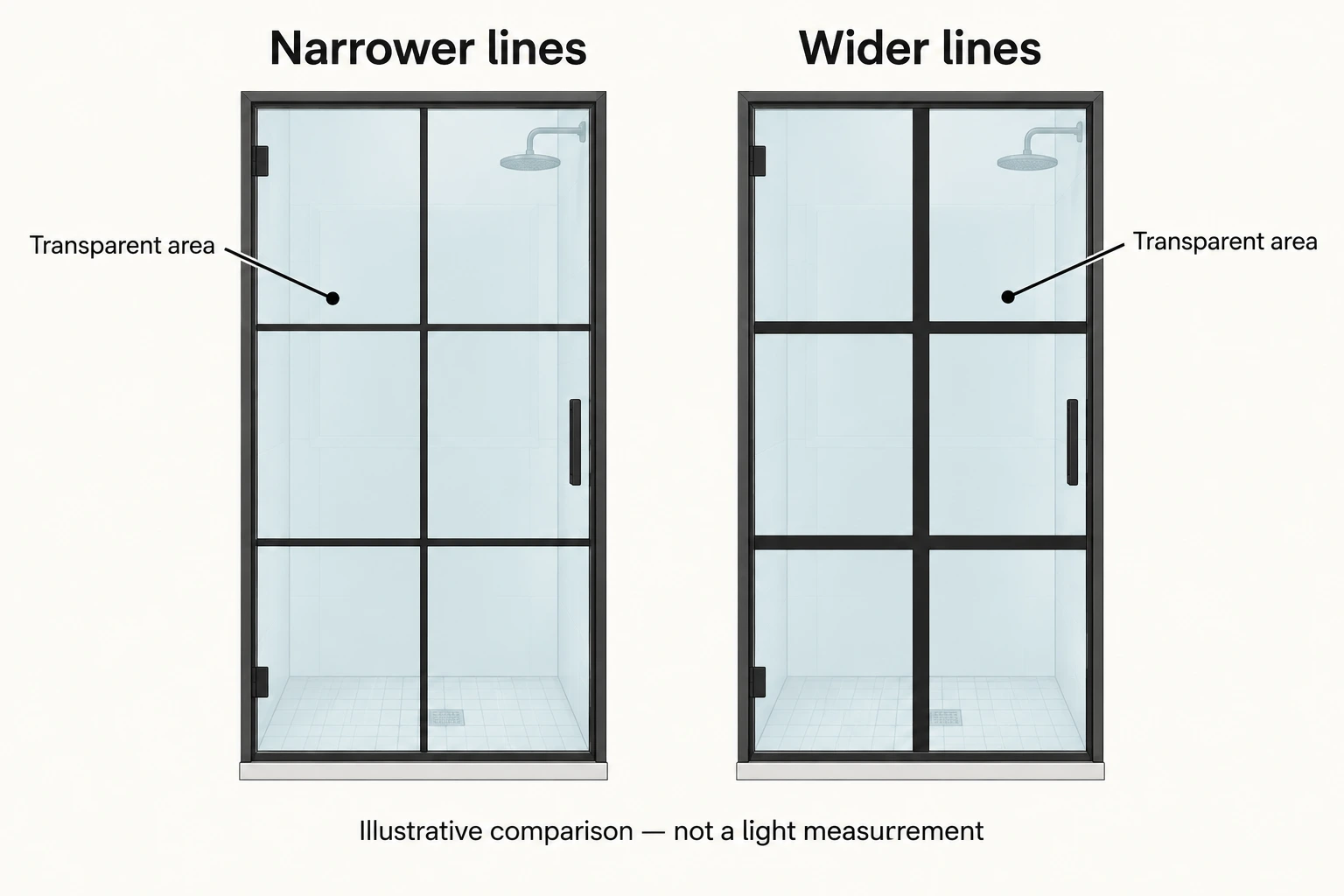
Wider lines cover more of the same-size pane. The drawing shows that coverage, without measuring room brightness.
Look at your own light sources: the window outside the enclosure, a ceiling light inside it, or fixtures above the vanity. A door between the window and shower needs a different assessment from a shower with its own light. If you can view a similar enclosure, compare day and evening conditions. The showroom’s bright window won’t arrive in the box with your door.
Compare the grid against the whole room
Sketch the door beside your tile pattern, vanity, and window. Compare a sparse and denser grid on that same drawing to see how much pattern you want across the shower.
A dense grid against small patterned tiles can look like checks with stripes: you may love the mix, or find it busy. Explore that styling choice on paper. Even in a well-lit room, pattern and brightness are different questions.
Add the handle and outside frame to the sketch. Ask whether the grid continues across fixed panels or changes at the opening door. Judge the whole enclosure. A rough drawing is enough; you’re comparing line positions, not entering an architecture prize.
The grid makes a strong style statement. Choose a pattern you’ll still enjoy after the current trend moves on, especially if you plan to keep the bathroom for years.
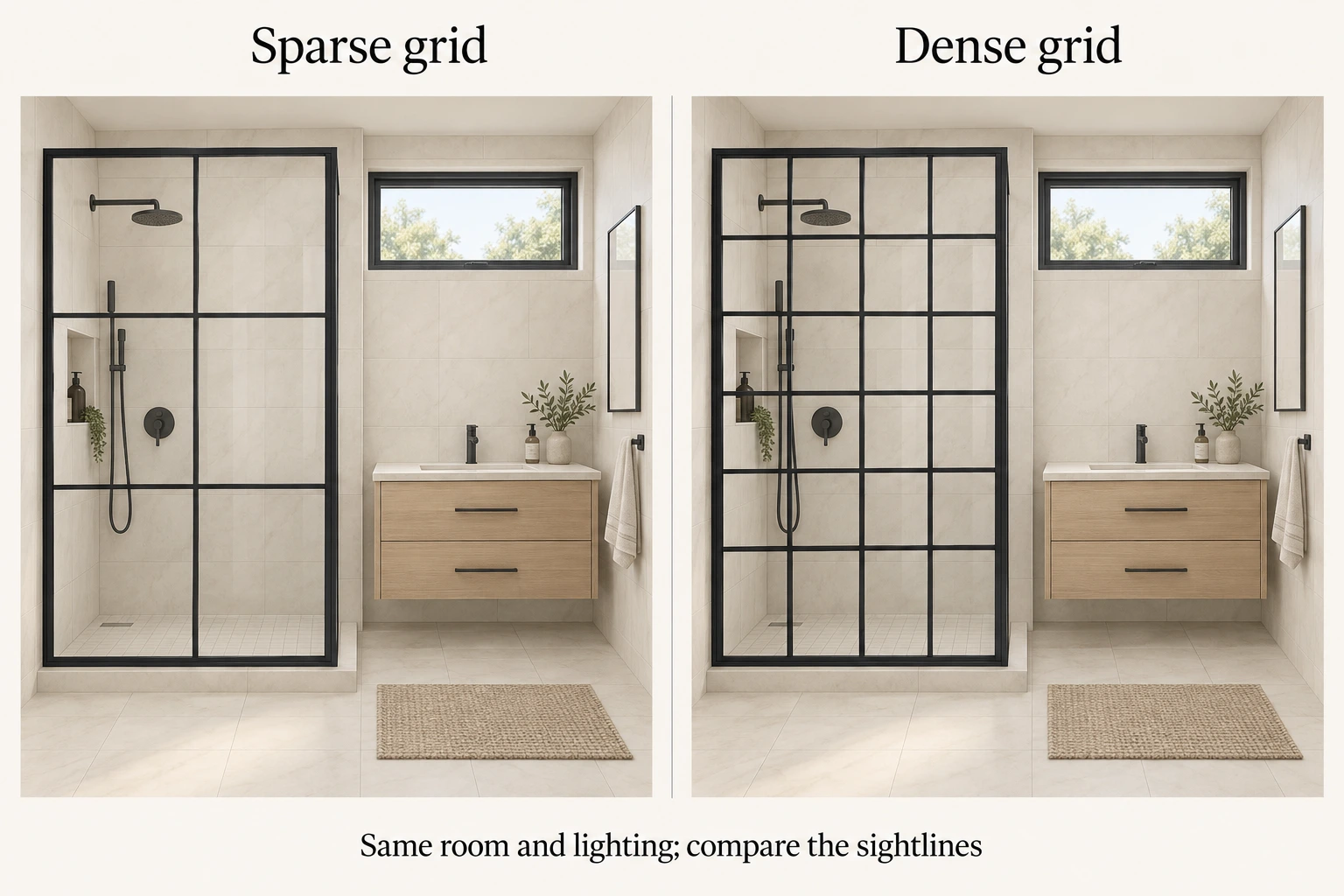
The bathroom stays the same; only the grid layout changes. Compare the view through the lines. This is a styling illustration, not a lighting simulation.
Black grid shower door cleaning: compare surfaces before buying
For black grid shower door cleaning, follow the path your cloth or squeegee will take. Raised bars act like speed bumps on the side where they sit. Similar-looking doors can put those bumps in different places, so ask which side carries the grid and how far it stands out.
Printed grid vs. metal grid shower doors
Printed lines put the pattern on glass; applied metal strips add physical edges. HMI documents both options, including exterior adhesive strips and printing on either face. Get the construction spelled out; the finish name won’t describe the cleaning surfaces.
Coastal puts its Gridscape 1 grid outside the glass, leaving fewer raised bars in the wet-side wiping path. The outside edges still need cleaning. This follows the construction; it isn’t a timed cleaning trial.
| Construction | Cleaning access to check |
|---|---|
| Printed pattern | No applied metal bars at the print; verify surface texture and approved care. |
| Raised exterior grid | Check the unobstructed inner face and access around outer edges. |
| Raised grid exposed to shower water | Inspect the wiping path around bars and joints before ordering. |
If cleaning around bars would make you put it off, consider a printed grid. Check its texture and care sheet. “Printed” guarantees neither a perfectly smooth surface nor retirement for your cleaning cloth.
Inspect the door edge and both glass faces using the cleaning tool you’d use at home. Raised horizontal strips create edges to work around; printed lines may leave a different path. Check bottom corners and handles too, beyond the easy middle of the pane.
For panel overlaps and swing space, compare sliding versus hinged cleaning access.
Ask whether the metal bars sit on one pane or separate individual glass sections. Coastal’s documented example uses aluminum-alloy framing. A factory-window look doesn’t establish that a door is steel; get the actual material and construction onto the quote.
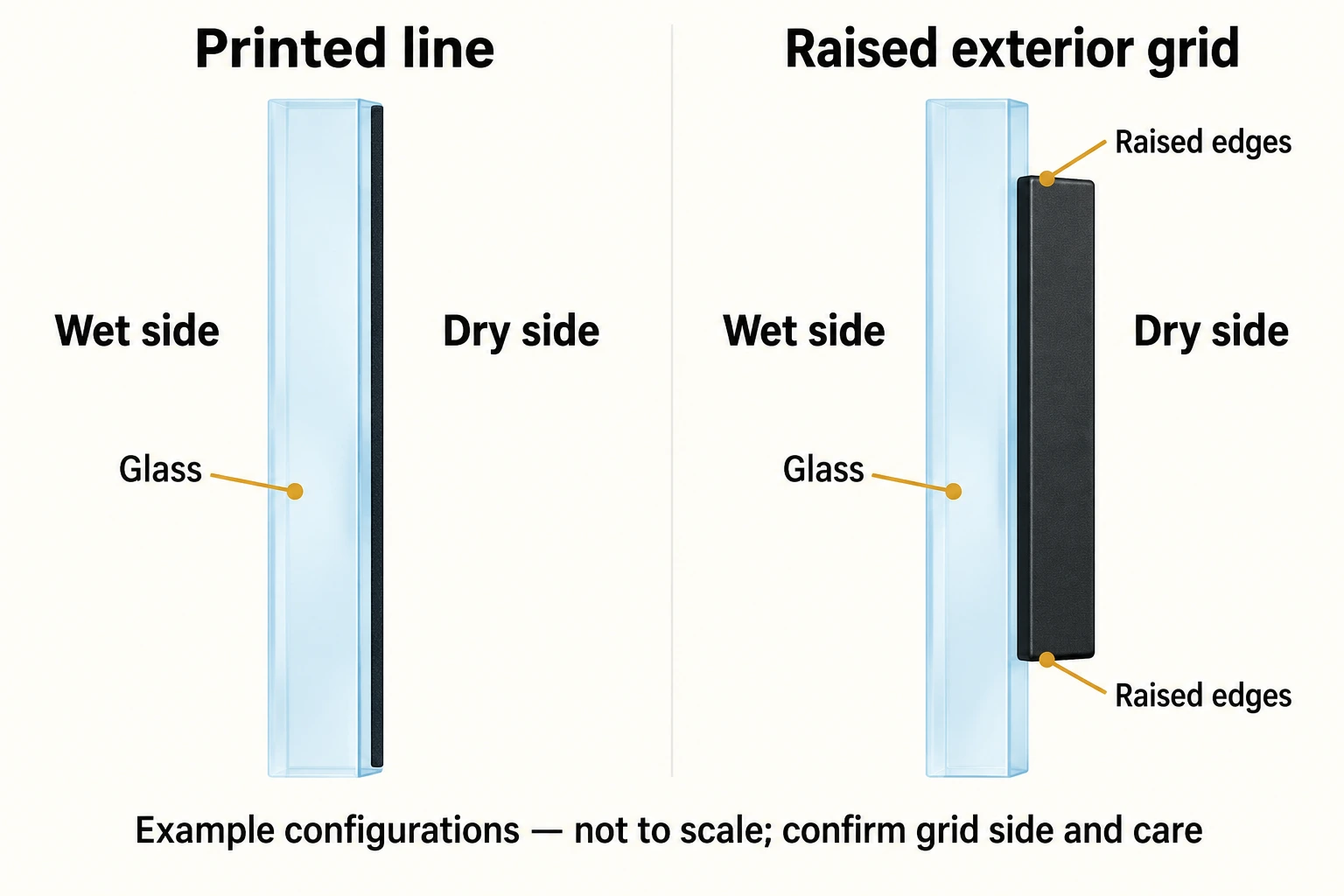
The printed line and raised exterior grid have different surface profiles. Check the actual side, texture, and care instructions for the door you buy.
How to clean black grid shower doors without damaging the finish
After showering, remove water with the approved tool. HMI’s general care sheet recommends drying after water exposure and warns against abrasive or acid-based enclosure cleaners. Make drying part of the routine rather than leaving the door wet until deeper cleaning.
Read the instructions for the glass treatment separately. HMI’s C.10 glass instructions allow mild detergent for routine cleaning and white vinegar for mineral marks. That permission applies to the described glass treatment. It doesn’t automatically carry over to the grid print, black metal finish, or neighboring seals.
Use the specified soft cloth around accessible exterior strip edges, then dry the metal. If the finish peels or a strip lifts, photograph the damage and contact the supplier. Scrubbing harder won’t resolve a failing strip or finish.
Keep quick drying separate from deeper cleaning. Remove accumulated soap residue with the approved cleaner, checking grid intersections and the lower frame too. HMI’s C.10 instructions still require routine cleaning on treated glass. A coating doesn’t do the drying and wiping for you.
For hard water, ask which glass treatment comes with the door and how its care sheet handles mineral buildup. Keep it with the order. If instructions conflict, request written guidance for the assembled door. You’ll have a routine before deposits become a problem, without guessing which neighboring surfaces tolerate the glass cleaner.
Customer example: the vanity needed a place in the plan
During planning for the L-shaped corner enclosure below, our team pointed out that the vanity cabinet needed to be included in the measurements. It sat close to the shower corner, with its door panel beside the outside glass. Enough room to install the enclosure wouldn’t necessarily mean enough room to clean it.
Before approving the plan, the customer adjusted the cabinet depth to leave space for reaching the glass and metal frame. That addressed an access problem before it could become a daily nuisance. The lesson is simple: give your cleaning hand a place on the drawing, too. A handsome shower shouldn’t need a contortionist to maintain it.
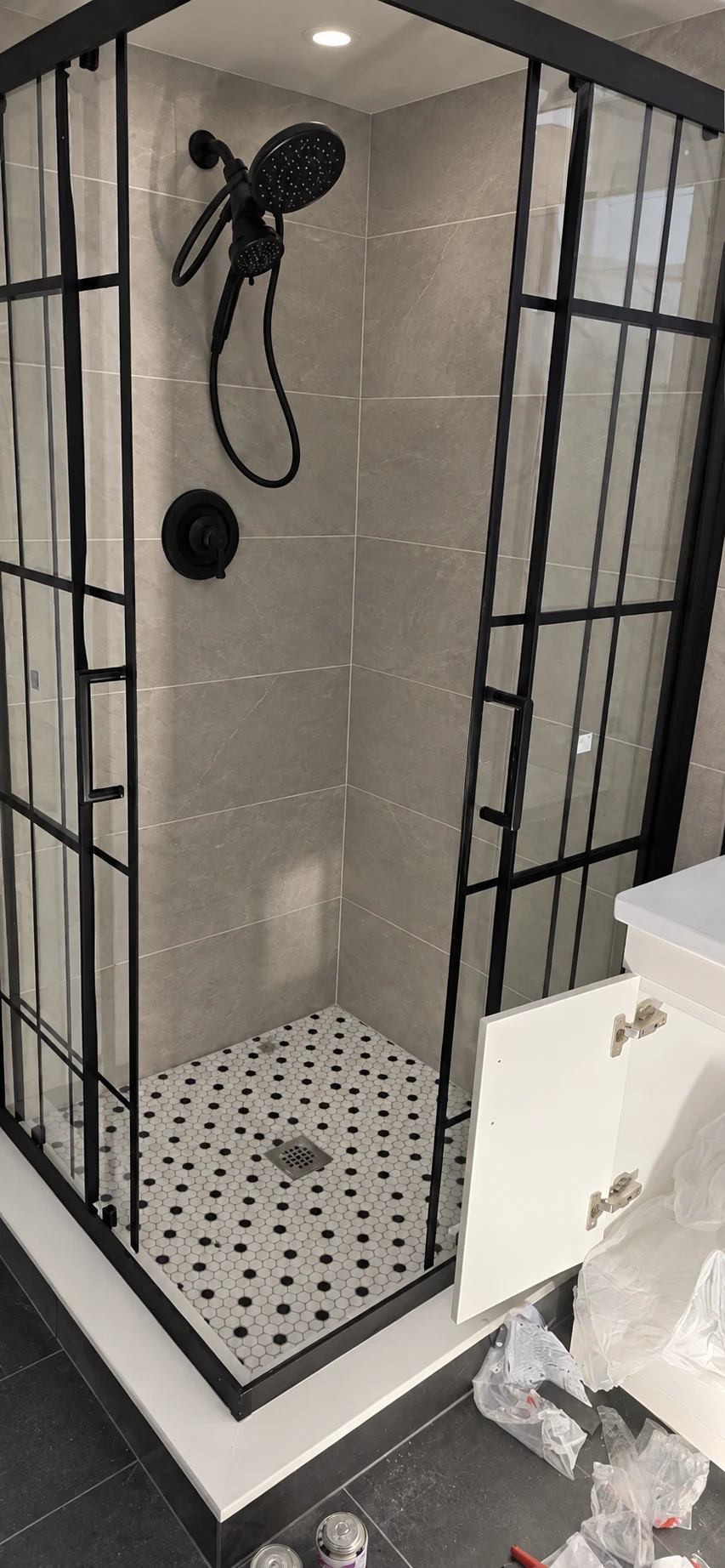
Customer photo: The cabinet beside this corner enclosure is why vanity depth belongs in the cleaning-access plan.
Ask the seller to document the cleaning surfaces
Before ordering black grid shower doors, measure the finished shower opening and get a specification naming the glass, grid material, and grid side. Request care sheets for the complete configuration, including the print and protective treatment.
Ask whether adhesive, clips, or frame retention hold the grid in place. Get the warranty terms for lifting, detachment, and replacement for that specific attachment method.
Get the black finish warranty in writing for both the grid and hardware.
A useful quote lets you spot substitutions. “Black grid glass” could mean printed lines, adhesive strips, or a framed assembly. Request the pattern drawing with the material description. Put your exact privacy glass or printed area on the approved order, beyond the showroom conversation.
For custom black grid shower doors, put the glass and grid specification in writing before approving the order, so you have a defined configuration to check when it arrives.
| Your priority | Specification to request |
|---|---|
| Privacy | Named obscure glass or privacy treatment, with a sample. |
| Light and sightlines | Glass sample and a grid elevation showing line coverage. |
| Fewer raised edges | Printed-grid details or an exterior-only grid layout. |
| Cleaning access | Access to both glass faces, grid edges, and door overlaps. |
| Raised-grid weight | Confirm the hinges or pivots are rated for the door’s total weight, including the grid assembly, within their specified width limits. |
| Lead time | Stock, made-to-order, or custom; confirm the quoted lead time alongside the grid type. |
CRL’s hardware catalog lists door-weight and width limits. Check the hinges or pivots against the complete door, including any raised grid, and stay within the stated width limits. For a pivot door, also check the pivot-door supports. Good looks won’t take weight off the hinges.
Have the seller demonstrate cleaning the overlapping glass and the outside face beside a vanity. Try the door open and closed. If it needs space you won’t have, change the configuration. Entering and cleaning the shower shouldn’t require a new yoga pose.
Take the spec table to a local showroom, or send it with your measurements when requesting quotes online.
Conclusion
Choose black grid shower doors with the screening you need, a pattern that suits the room, and surfaces you can reach. Then choose a shower door that fits your bathroom, checking its movement and finished opening before ordering. A good-looking door should earn its place on an ordinary weekday too.
FAQ
Q: What determines privacy in black grid shower doors?
The glass and privacy treatment do the screening. Clear black grid shower doors leave a view between the lines. Coastal’s clear and obscure options show why the glass needs its own specification.
Q: How do black grid shower doors affect light?
Opaque lines block the areas they cover; uncovered glass lets light through. Room lighting and glass treatment also matter. This guide doesn’t give a measured light-loss percentage to apply to every door.
Q: Why does grid placement change cleaning access?
Raised bars interrupt wiping on their side of the glass. Coastal’s exterior-only grid moves them outside the wet face. You still need access to clean the outer edges.
Q: Who should choose printed grids instead of raised metal grids?
Consider a printed grid if you’d prefer fewer raised bars to clean around. HMI offers printed and applied options; confirm the print’s texture and care requirements, plus the glass privacy, before ordering.
Sources to check
Use these with the exact product and room conditions behind your decision.
- KOHLER U.S. shower-door glass optionsU.S. catalog lists clear, frosted, and frosted privacy-band glass; confirm the available combination for the selected model.
- Coastal Gridscape 1Clear and obscure glass options, exterior-only grid, and aluminum-alloy framing.
- HMI Grid ShowersPrinted grids, exterior adhesive strips, print-side choices, and optional privacy shield.
- HMI Priva-TechConfigurable printed privacy area and transition; coverage should be shown on the enclosure drawing.
- VIGO MeridianNamed clear-glass grid-door example; no measured light comparison is inferred.
- KOHLER modern shower glass guideFrosted glass softens visibility while allowing light through.
- HMI general care instructionsDrying and general enclosure care; distinguish treatment-specific permissions from metal and print care.
- HMI C.10 care instructionsMild detergent and white-vinegar permissions for the described glass treatment, not all adjoining surfaces.
- CRL hardware capacity guidanceManufacturer catalog search extract specifies door-weight and width limits; confirm the exact hardware's capacity for the complete moving door assembly.
- Customer photographs and project accountsTwo original photos and their selection and planning accounts were supplied by the Aurivedo team on October 2, 2026. The team described the sliding-door customer's choice and feedback, and its own vanity-clearance advice. The accounts are not independently verified performance tests; no customer identity, location, model, or installation date is assigned.
- Illustration scopeThe cover and three comparison diagrams explain design and construction choices. They do not document product tests or customer installations.